


Photo-AFP
“Myanmar’s Key Stakeholders and their Perceptions of Sino-Myanmar Relations – A Survey (2024),” was published in August, 2025, as a translation of the original Burmese version published in June, 2025. This survey is a part of research conducted by the ISP-Myanmar’s China Studies. ISP-Myanmar has been conducting this annual survey since 2022, making the 2024 survey the third iteration.
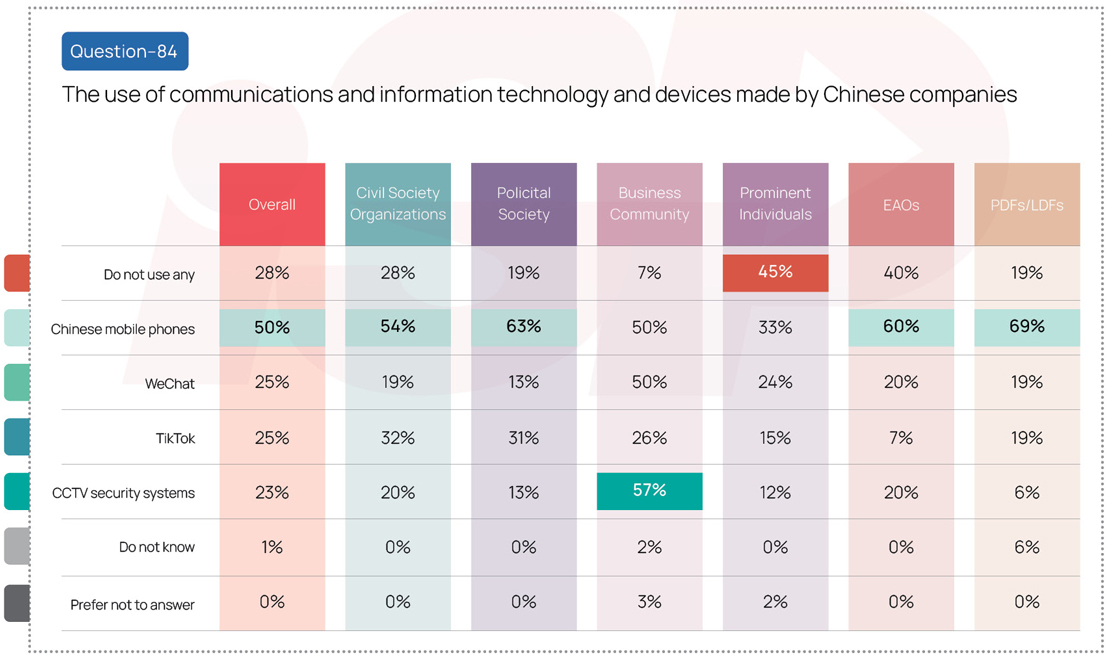
Question–84
The use of communications and information technology and devices made by Chinese companies
For survey question No. 84, respondents were asked whether they use communications and information technology and devices made by Chinese companies from a given list, with the option to select more than one if applicable.

The survey revealed that 28 percent of respondents reported they do not use any of the listed Chinese-made products. However, 50 percent indicated using Chinese-made mobile phones, 25 percent used WeChat, 25 percent used TikTok, and 23 percent used Chinese CCTV security systems. Compared to the 2023 survey, no significant changes were observed.
Analysis of the Survey Results
Usage of Chinese-made communications and information technology and devices varied across the six stakeholder groups. PDFs/LDFs and the political society group were the highest users of Chinese-made mobile phones, with 69 percent and 63 percent respectively. EAOs reported the lowest use of TikTok, with only seven percent indicating usage. The business community showed the highest usage of WeChat and Chinese CCTV security systems, with 50 percent and 57 percent respectively.
Questions–85 to 87
Perceived level of security and privacy associated with Chinese technology
For survey questions No. 85 to 87, respondents were asked about their perceived level of security and privacy associated with each item from the list of communication and information technology devices made by Chinese companies that they presently use.

Question–88
Perceived level of security and privacy associated with Chinese technology
For survey question No. 88, respondents were asked about their perceived level of security and privacy associated with each item from the list of communication and information technology devices made by Chinese companies that they presently use.

Although many respondents used mobile phones made by Chinese companies, when asked about the perceived security of these phones, 73 percent responded that they do not feel secure. Similarly, regarding the use of WeChat, 64 percent answered that they do not feel secure. For TikTok, 63 percent expressed concerns about its security, while 69 percent believed CCTV security systems were not secure. Notably, perceptions of insecurity regarding Chinese-made communications, information, and technology devices rose by 13 to 19 percentage points compared to the 2023 survey.
Analysis of the Survey Results
The survey reveals that among the six respondent communities, CSOs and EAOs expressed the highest share of concerns about the security of mobile phones made by Chinese companies, with 80 percent rating them as not secure. Prominent individuals and CSOs showed the highest share of concern regarding Chinese made CCTV systems, 78 percent believed they were not secure, and 71 percent thought WeChat was insecure. More than three-fourths (76 percent) of CSOs rated TikTok as not secure.


Unless otherwise stated, responses of “Not secure at all” and “Not secure” were grouped under “Not secure,” while “Secure” and “Very secure” were grouped under “Secure,” for the purpose of analysis.
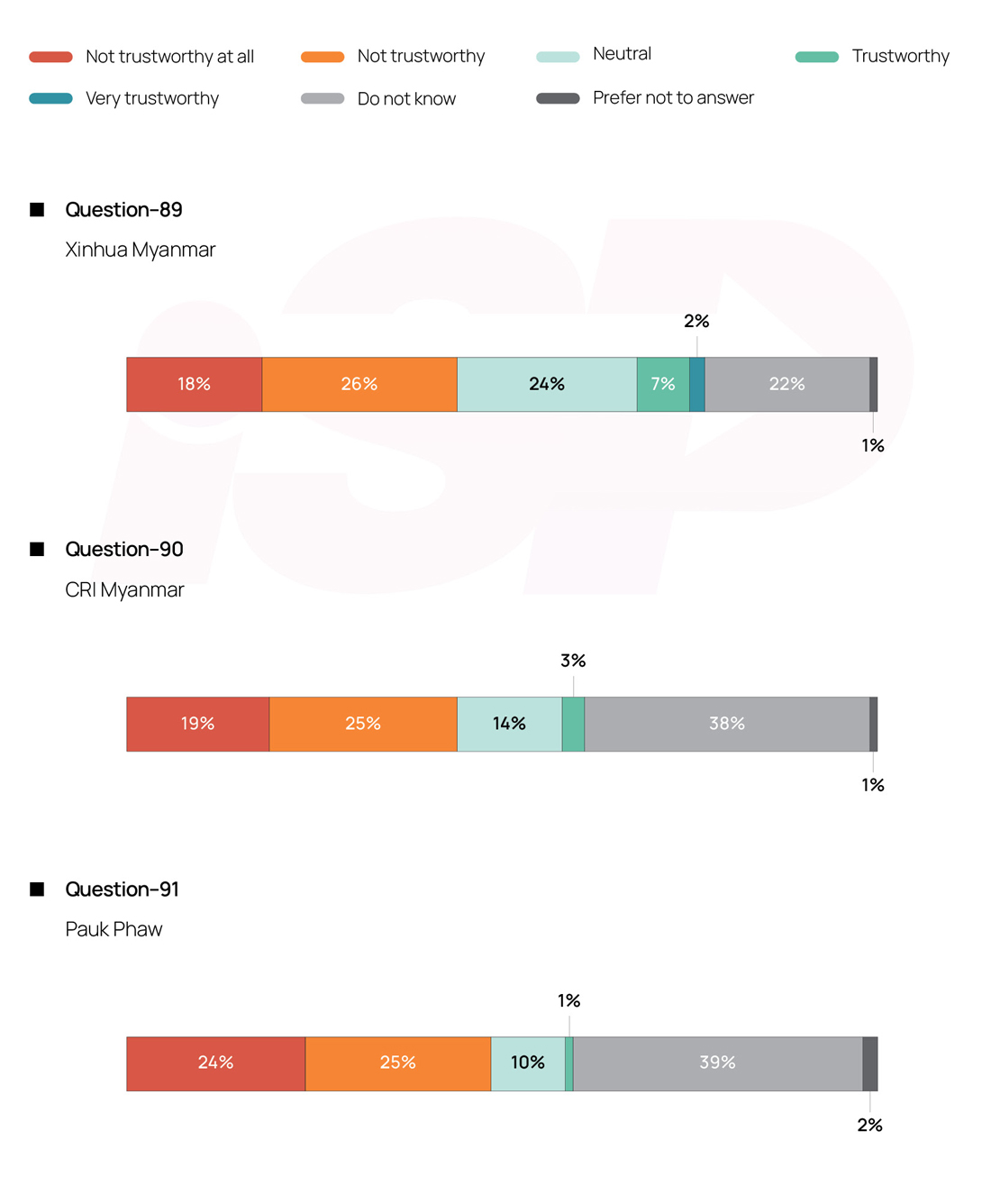
Questions–89 to 91
Perceived Trust in Chinese State-Owned Media
For survey questions No. 89 to 91, respondents were asked about their perceived level of trust in Chinese state-owned media outlets broadcasting in the Burmese language. These questions were newly added in this round of survey.
Question–92
Perceived Trust in Chinese State-Owned Media
For survey question No. 92, respondents were asked about their perceived level of trust in Chinese state-owned media outlets broadcasting in the Burmese language. These questions were newly added in this round of survey.

For Xinhua Myanmar, 44 percent responded, “not trustworthy,” and 22 percent responded do not know. For CRI Myanmar, 44 percent answered “not trustworthy at all,” and 38 percent did not know. For ‘Pauk Phaw,’ 49 percent expressed a lack of trust, and 39 percent did not know. For Mingala, 48 percent believed it was not trustworthy, and 37 percent did not know.
Analysis of the Survey Results
The survey shows limited awareness and widespread distrust of Chinese state-owned media in Burmese language among Myanmar’s key stakeholder groups. Forty-four percent of the political society group reported being unaware of Xinhua Myanmar, while 56 percent of prominent individuals deemed it untrustworthy. Awareness of CRI Myanmar was also low: 75 percent of the political society group, 50 percent of the business community, 41 percent of CSO respondents, and 40 percent of EAOs said they were unfamiliar with it. Similarly, Pauk Phaw was poorly received, with 63 percent of PDFs/LDFs expressing distrust.

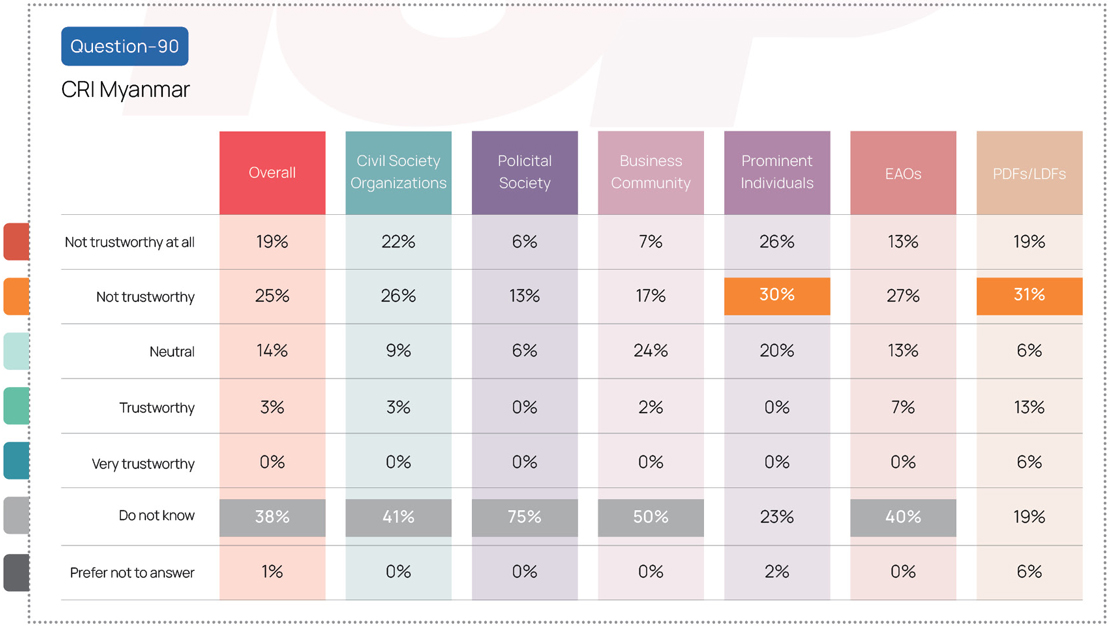


Unless otherwise stated, responses of “Not trustworthy at all” and “Not trustworthy” were grouped under “Not trustworthy,” while “Trustworthy” and “Very trustworthy” were grouped under “Trustworthy,” for the purpose of analysis.
- Myanmar’s Key Stakeholders and their Perceptions of Sino-Myanmar Relations – A Survey (2024)
- Key Findings
- General Perceptions of China
- Perceptions of China’s Role in Myanmar’s Political Crisis
- Perceptions of the Role of China in Myanmar’s Peace Processes
- Perceptions of China–Myanmar Economic Relations
- Perceptions of China–Myanmar Economic Corridor (CMEC) Projects
- Perceptions of China’s Regional Integration Plans Through Myanmar
- Perceptions of China’s Soft Power
-
Perceptions of the Use of Chinese Technology Currently reading