


Photo-AFP
“Myanmar’s Key Stakeholders and their Perceptions of Sino-Myanmar Relations – A Survey (2024),” was published in August, 2025, as a translation of the original Burmese version published in June, 2025. This survey is a part of research conducted by the ISP-Myanmar’s China Studies. ISP-Myanmar has been conducting this annual survey since 2022, making the 2024 survey the third iteration.
Question–79
How beneficial is China’s development aid?
Respondents were asked to assess the extent to which China’s development aid benefits communities in Myanmar, rating their perception on a scale from 1. Not beneficial at all to 4 .Very beneficial.

The survey revealed that 55 percent of respondents perceived China’s development aid as not beneficial, while 40 percent indicated it was beneficial. Compared with the 2023 survey, the share of respondents who viewed China’s aid as beneficial rose by 24 percentage points, while the proportion with negative view fell by 25 points.
Analysis of the Survey Results
Perceptions of the benefits of China’s development aid varied across the six stakeholder groups. CSOs were most likely to perceive China’s aid as not beneficial, with 63 percent reporting this view, followed by prominent figures (61 percent) and PDFs/LDFs (57 percent). Conversely, the political society group most strongly perceived the aid as beneficial, with 75 percent indicating this perception, followed by the business community (60 percent). Notably, EAOs showed an equal split, with 47 percent perceiving the aid as beneficial and 47 percent as not beneficial.
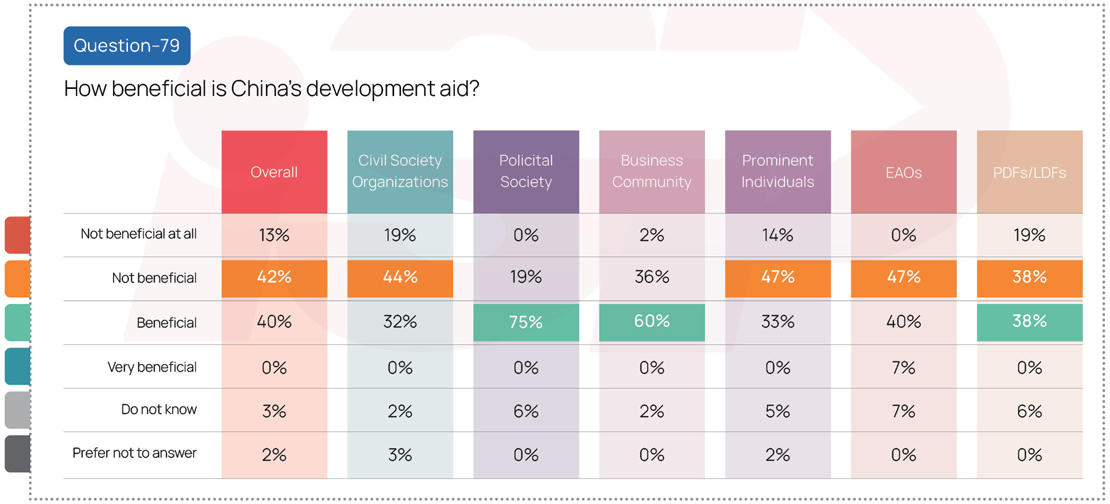
For analysis, responses of “Not beneficial at all” and “Not beneficial” were grouped under “Not beneficial,” while “Beneficial” and “Very beneficial” were grouped under “Beneficial.”
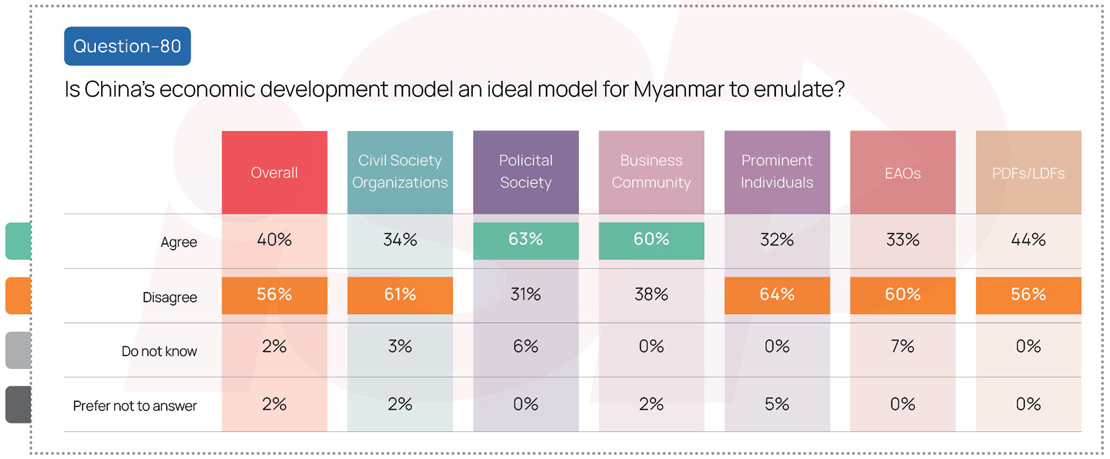
Question–80
Is China’s economic development model an ideal model for Myanmar to emulate?
For survey question No. 80, respondents were asked whether they agree or disagree with the statement that China’s economic development model is an ideal model for Myanmar’s economic development.

The survey revealed that 56 percent of respondents expressed disagreement with the statement that China’s economic development model is an ideal model for Myanmar, while 40 percent indicated agreement. Compared with the 2022 and 2023 surveys, disagreement rose by nine and two percentage points, respectively, while agreement declined by five points from 2022.
Analysis of the Survey Results
Perceptions of China’s economic development model as an ideal model for Myanmar varied across the six stakeholder groups. Prominent figures were most likely to express disagreement, with 64 percent reporting this view, followed by CSOs (61 percent), EAOs (60 percent), and PDFs/LDFs (56 percent). Conversely, the political society group most strongly indicated agreement, with 63 percent endorsing the model, followed by the business community (60 percent).
Question–81
Is democracy with Chinese characteristics a model for Myanmar to emulate?
For survey question No. 81, respondents were asked whether they agree or disagree with the statement that democracy with Chinese characteristics is suitable and should be adopted in Myanmar.

The survey revealed that 90 percent of respondents expressed disagreement with the idea that democracy with Chinese characteristics is suitable and should be adopted in Myanmar, while seven percent indicated agreement. Compared with the 2022 and 2023 surveys, disagreement rose by three percentage points, while agreement declined by one and two points, across the respective years.
Analysis of the Survey Results
Perceptions of democracy with Chinese characteristics as a suitable model for Myanmar were overwhelmingly negative across the six stakeholder groups. CSOs were most likely to express disagreement, with 95 percent reporting this view, followed by prominent figures (94 percent), EAOs (93 percent), PDFs/LDFs (88 percent), the political society group (81 percent), and the business community (74 percent). Among those who agree with the statement, the business community had the highest percentage at 19 percent.

Question–82
Should Myanmar emulate China’s governance model?
For survey question No. 82, respondents were asked whether they agreed or disagreed with the statement that China’s governance model is suitable and should be adopted in Myanmar.

The survey revealed that 85 percent of respondents expressed disagreement with the idea that China’s governance model is suitable and should be adopted in Myanmar, while 10 percent indicated agreement. Compared to the 2023 survey, disagreement increased by six percentage points, and agreement decreased by six points.
Analysis of the Survey Results
Perceptions of China’s governance model as a suitable model for Myanmar were predominantly negative across the six stakeholder groups. CSOs were most likely to express disagreement, with 93 percent reporting this view, followed by PDFs/LDFs (88 percent), prominent individuals (86 percent), EAOs (80 percent), the political society group (69 percent), and the business community (67 percent). Meanwhile, 25 percent of the political society group and 24 percent of the business community agreed on the model’s suitability.

Question–83
Have you ever participated in trips or training programs to China organized by Chinese institutions?
For survey question No. 83, respondents were asked whether they had participated in study tours or training programs organized by the Chinese government, businesses, universities, or other institutions, and if they did so, how many times.
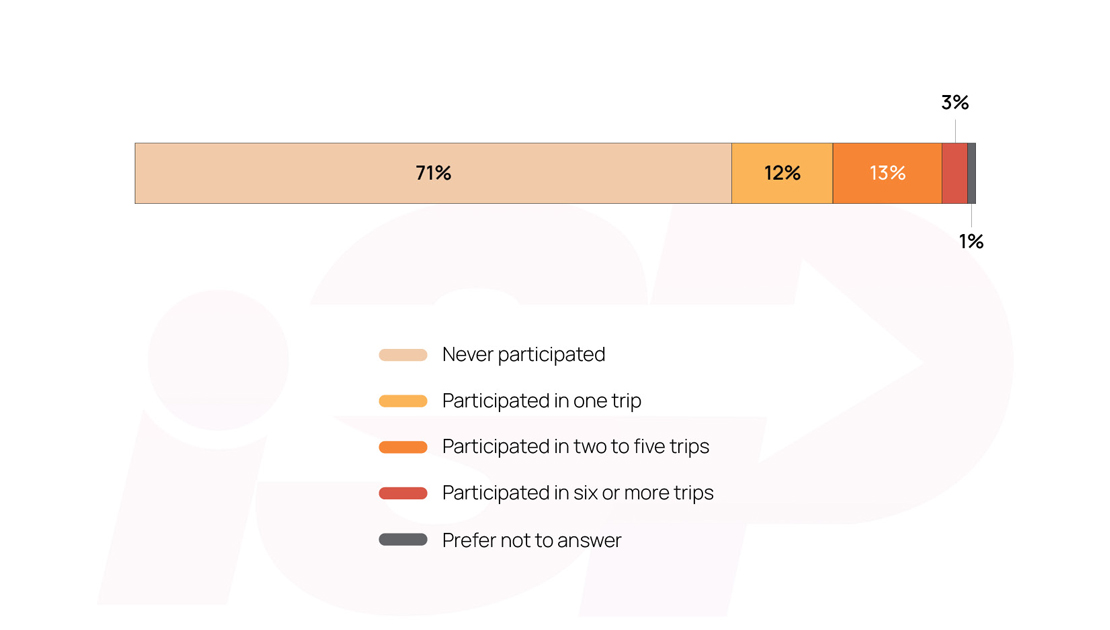
The survey revealed that 71 percent of respondents reported they had never participated in study tours or training programs organized by China. Twelve percent indicated they had participated in one trip, while 13 percent reported participating in two to five trips.
Analysis of the Survey Results
Participation in study tours or training programs to China organized by Chinese institutions varied across the six stakeholder groups. PDFs/LDFs were most likely to report never participated, with 94 percent indicating this, followed by CSOs (86 percent) and the political society group (69 percent). The business community had the highest participation rates, with 21 percent reporting one trip and 26 percent indicating two to five trips.
