

Photo-AFP
“Myanmar’s Key Stakeholders and their Perceptions of Sino-Myanmar Relations – A Survey (2024),” was published in August, 2025, as a translation of the original Burmese version published in June, 2025. This survey is a part of research conducted by the ISP-Myanmar’s China Studies. ISP-Myanmar has been conducting this annual survey since 2022, making the 2024 survey the third iteration.
Questions–68 to 71
Awareness of China’s regional integration initiatives
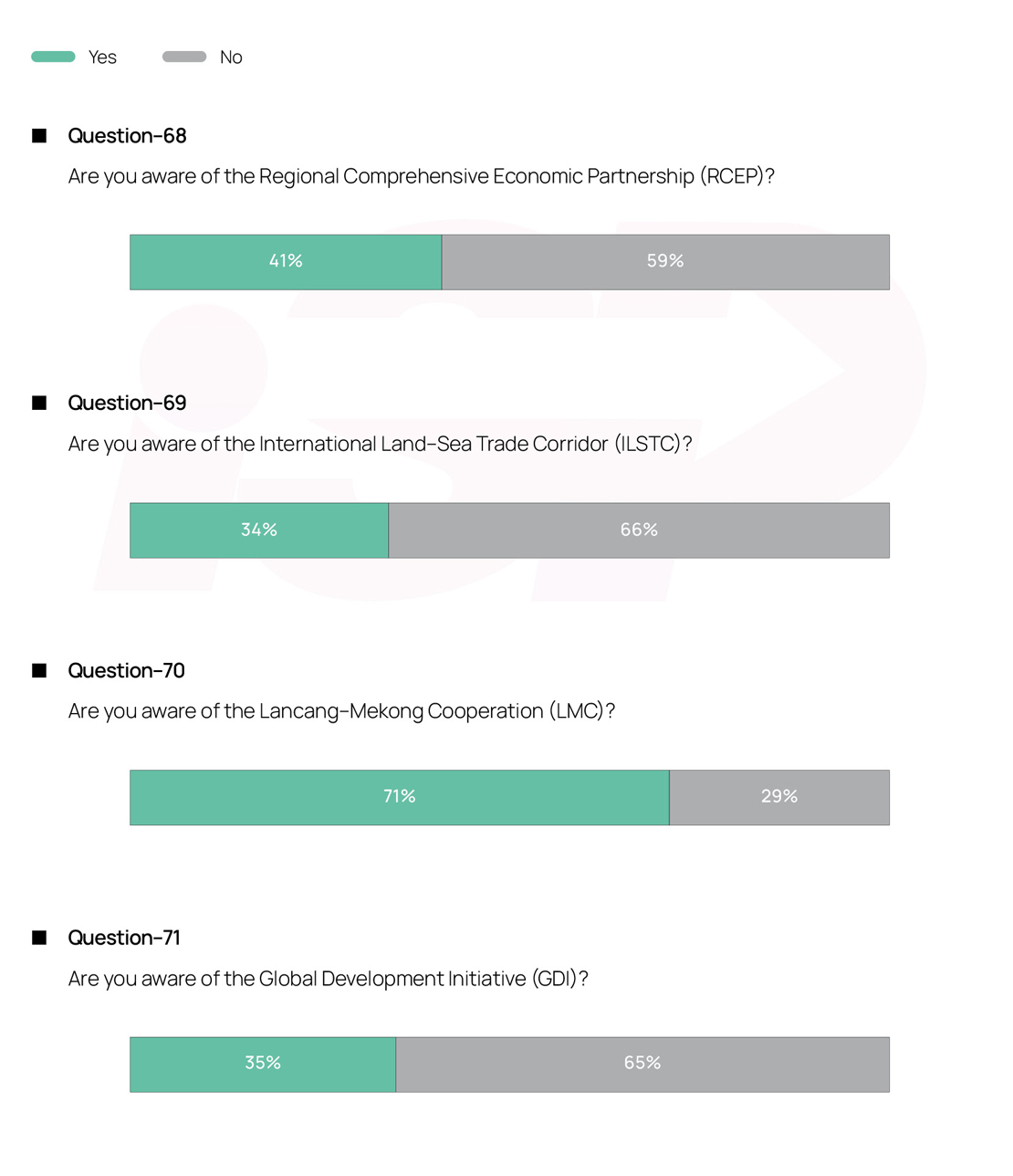
For survey questions No. 68 to 71, respondents were asked about their awareness of China’s regional integration initiatives implemented in Myanmar following the 2021 coup. This set of questions was newly introduced in this current survey.
Question–72
Awareness of China’s regional integration initiatives
For survey question No. 72, respondents were asked about their awareness of China’s regional integration initiatives implemented in Myanmar following the 2021 coup. This question was newly introduced in this current survey.

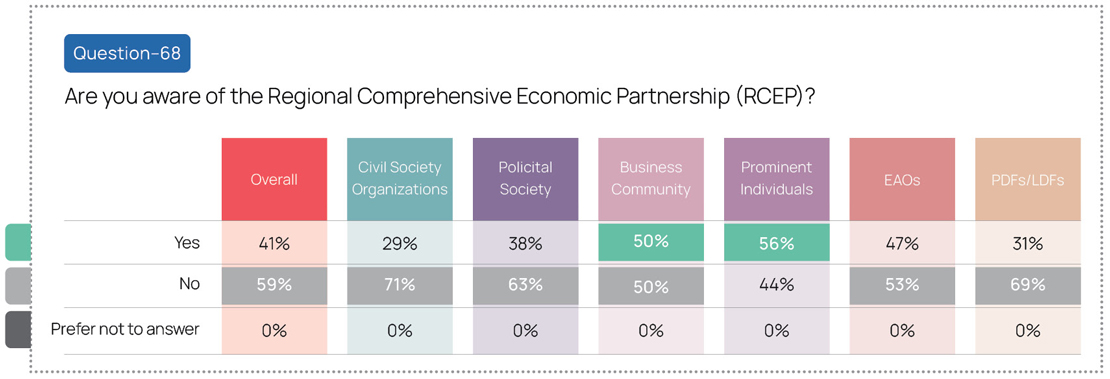
The survey revealed that a majority of respondents were unaware of many of China’s regional integration initiatives. The LMC was the only initiative which had more respondents (71 percent) who said they were aware of the initiative than those who were not (29 percent). Regarding the RCEP, 59 percent reported being unaware, while 41 percent indicated awareness. For the ILSTC, 66 percent were unaware, and 34 percent were aware. The GDI was unknown to 65 percent, with 35 percent aware, and the GSI was unknown to 67 percent, with 33 percent indicating awareness. Compared with the 2023 survey, awareness rose across all six stakeholder groups. Recognition of the RCEP increased by eight percentage points, the LMC by 13 points, and the GSI by eight points. Awareness of the ILSTC and the GDI also edged up slightly.
Analysis of the Survey Results
Awareness of China’s regional integration initiatives varied across the six stakeholder groups, with notable differences emerging primarily in relation to the RCEP. While awareness levels for most initiatives were generally consistent—either aware or unaware—across all groups, the RCEP stood out as the only initiative with markedly divergent proportions of awareness among different stakeholder groups. For the RCEP, the business community (50 percent) and prominent individuals (56 percent) reported the highest share of awareness, while the majority of other groups: CSOs (71 percent), PDFs/LDFs (69 percent), and political society (63 percent) reported being unaware of the initiative. Regarding the ILSTC, awareness was limited overall. Prominent individuals (42 percent), EAOs (33 percent), and the business community (33 percent) demonstrated familiarity, while the majority of PDFs/LDFs (81 percent), political society (75 percent), and CSOs (68 percent) reported the highest share of unawared stakeholders. The LMC initiative registered the highest overall awareness among all initiatives, with a majority of respondents from most stakeholder groups reporting familiarity. The business community (88 percent), prominent individuals (82 percent), and EAOs (80 percent) demonstrated the highest share of awareness. In contrast, awareness was notably lower among PDFs/LDFs (44 percent), CSOs (41 percent), and the political society group (31 percent), where most respondents indicated unfamiliarity with the initiative. For the GDI, PDFs/LDFs (44 percent) reported the highest share of awareness, followed by prominent individuals (42 percent) and EAOs (40 percent), while the political society group (75 percent), CSOs (70 percent), and the business community (62 percent) were unaware of the initiative. Awareness of the GSI was low across all groups. Prominent figures (41 percent) and EAOs (40 percent) reported the highest share of familiarity. However, the majority of stakeholders remained unaware, particularly within the political society group (88 percent), CSOs (70 percent), and PDFs/LDFs (69 percent).


Question–73
The goal of China’s regional integration initiatives
Respondents were asked to select one perceived objective of China’s regional integration initiatives from a provided list. This question was newly introduced in this current survey.

According to the survey, 58 percent of respondents believed China’s objective is to build a China-led regional political, economic, and security framework. Another 32 percent viewed it as an effort to expand geopolitical influence in the region, including Myanmar.
Analysis of the Survey Results
Perceptions across stakeholder groups were relatively similar; the dominant view in all six was that China aims to establish a China-led regional framework, EAOs (67 percent), PDFs/LDFs (63 percent), and CSOs (61 percent) viewed this way. Meanwhile, the view that China seeks to expand geopolitical influence was also noted by prominent individuals (35 percent), CSOs (34 percent), and EAOs (33 percent).

Questions–74 to 76
Who benefits from China’s regional integration initiatives?
For survey questions No. 74 to 76, respondents were asked to assess the extent to which China’s regional integration initiatives benefit various organizations and groups in Myanmar, rating their perception on a scale from 1. Not beneficial at all to 4. Very beneficial.

Questions–77 and 78
Who benefits from China’s regional integration initiatives?
For survey questions No. 77 and 78, respondents were asked to assess the extent to which China’s regional integration initiatives benefit various organizations and groups in Myanmar, rating their perception on a scale from 1. Not beneficial at all to 4. Very beneficial.

Respondents broadly perceived two distinct camps in relation to the beneficiaries of China’s regional integration initiatives: those who benefit—namely the SAC, EAOs, and private business owners—and those who do not, particularly the NUG and ordinary citizens. An overwhelming majority (91 percent) believed the initiatives benefit the SAC, with only 5 percent expressing the opposite view. Similarly, 80 percent saw private business owners as beneficiaries, compared to 14 percent who disagreed. Perceptions toward EAOs were more mixed, though still leaned positive: 55 percent believed they benefit, while 37 percent did not. In stark contrast, only 13 percent of respondents viewed the NUG as benefiting from these initiatives, with 75 percent believing they do not. Likewise, just 25 percent believed Myanmar citizens benefit, while a substantial 69 percent indicated they do not.
Analysis of the Survey Results
Perceptions on who benefits from China’s regional integration initiatives were largely consistent across stakeholder groups, with notable exceptions in views from EAOs regarding their own benefit and from the business sector regarding benefits to ordinary citizens. The belief that the initiatives primarily benefit the State Administration Council (SAC) was nearly universal—endorsed by 100 percent of PDFs/LDFs, 94 percent of the political society group, 91 percent of prominent individuals, and 91 percent of the business community. Views on whether EAOs benefit were more divided: while EAOs themselves (54 percent), CSOs (39 percent), and prominent individuals (39 percent) reported no perceived benefit, other groups such as CSOs (61 percent), the business community (60 percent), and PDFs/LDFs (56 percent) saw the EAOs as beneficiaries. Perceptions of the National Unity Government (NUG) as a beneficiary were minimal. Only a small portion of the business community (17 percent), CSOs (21 percent), and PDFs/LDFs (13 percent) believed that the NUG derived benefit, while strong majorities across PDFs/LDFs (88 percent), EAOs (87 percent), and prominent figures (82 percent) believed otherwise. Notably, no respondents from EAOs perceived any benefit to the NUG. Opinions on benefits to ordinary citizens were more polarized. The business community (52 percent), political society (38 percent), and EAOs (27 percent) believed citizens benefit to some extent, while large majorities in CSOs (85 percent), PDFs/LDFs (76 percent), and prominent individuals (68 percent) disagreed. Perceptions of benefit to private business owners were more favorable and widely shared. PDFs/LDFs (88 percent), political society (88 percent), and CSOs (82 percent) strongly believed they benefit, including the business sector themselves (67 percent). Very few respondents—CSOs (16 percent), prominent individuals (15 percent), EAOs (13 percent), and PDFs/LDFs (13 percent)—thought otherwise.
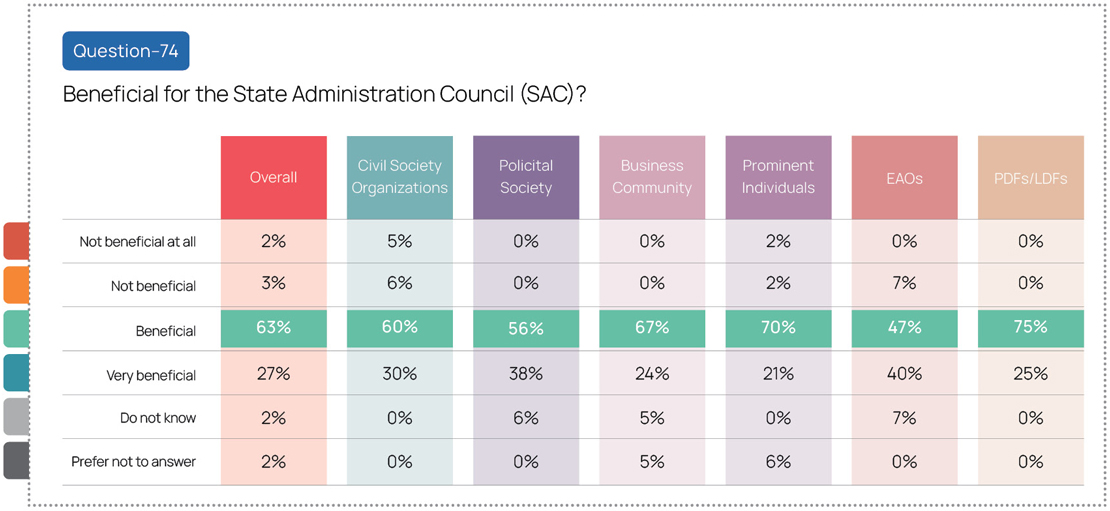


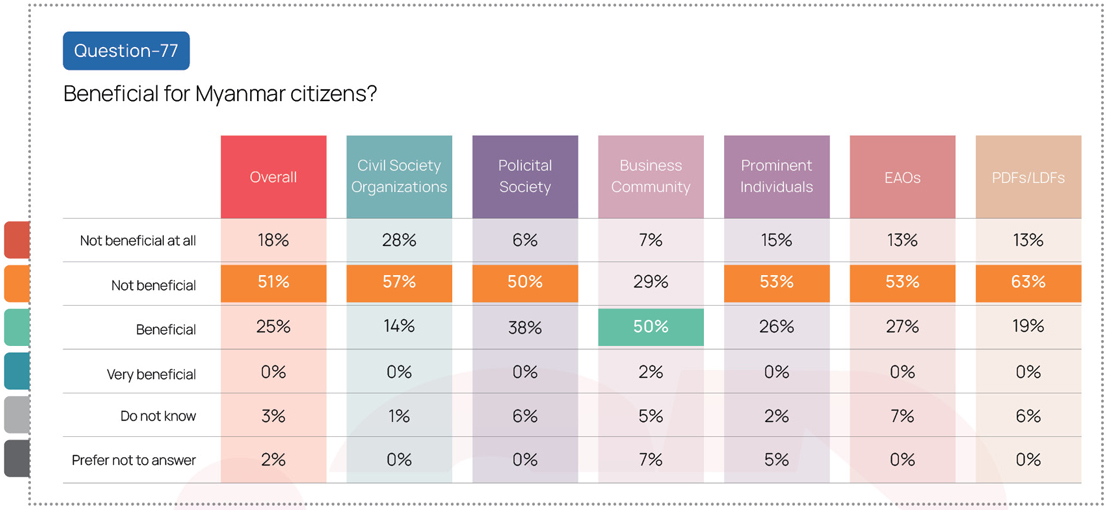

Unless otherwise stated, responses of “Not beneficial at all” and “Not beneficial” were grouped under “Not beneficial,” while “Beneficial” and “Very beneficial” were grouped under “Beneficial,” for the purpose of analysis.
- Myanmar’s Key Stakeholders and their Perceptions of Sino-Myanmar Relations – A Survey (2024)
- Key Findings
- General Perceptions of China
- Perceptions of China’s Role in Myanmar’s Political Crisis
- Perceptions of the Role of China in Myanmar’s Peace Processes
- Perceptions of China–Myanmar Economic Relations
- Perceptions of China–Myanmar Economic Corridor (CMEC) Projects
-
Perceptions of China’s Regional Integration Plans Through Myanmar Currently reading
- Perceptions of China’s Soft Power
- Perceptions of the Use of Chinese Technology