

Photo-AFP
“Myanmar’s Key Stakeholders and their Perceptions of Sino-Myanmar Relations – A Survey (2024),” was published in August, 2025, as a translation of the original Burmese version published in June, 2025. This survey is a part of research conducted by the ISP-Myanmar’s China Studies. ISP-Myanmar has been conducting this annual survey since 2022, making the 2024 survey the third iteration.
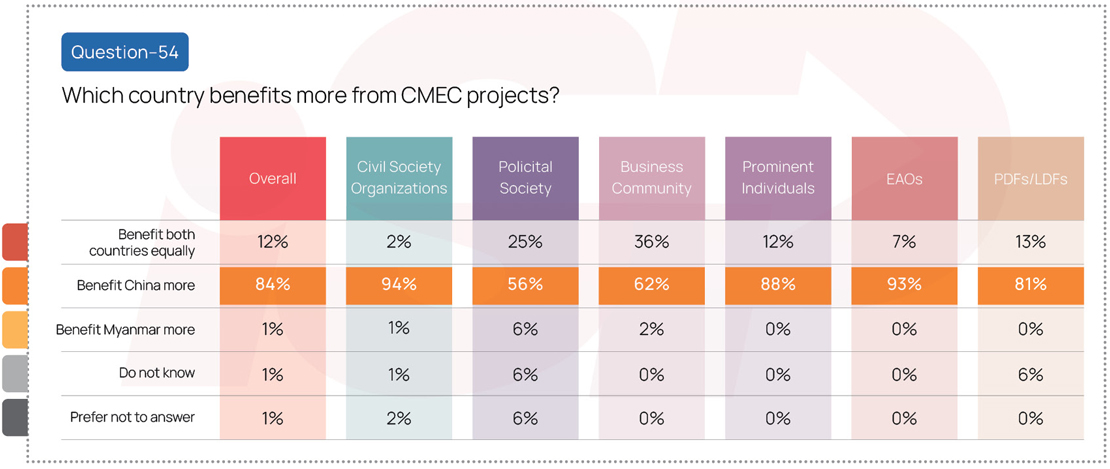
Question–54
Which country benefits more from CMEC projects?
For survey question No. 54, respondents were asked to identify whether CMEC projects would be mutually beneficial, more beneficial to China, or more beneficial to Myanmar.

The majority of respondents – 84 percent – perceived that CMEC projects brought more benefit to China, while 12 percent indicated the projects as being beneficial to both countries equally. Only one percent viewed the projects as more beneficial to Myanmar. There were no significant differences compared to previous surveys.
Analysis of the Survey Results
The survey revealed that across all respondent groups, CMEC projects are perceived to benefit China more. This sentiment was shared by CSOs (94 percent), EAOs (93 percent), prominent individuals (88 percent), PDFs/LDFs (81 percent), the business community (62 percent), and the political society group (56 percent). In contrast, among those who viewed the projects as mutually beneficial, the business community group recorded the highest share, at 36 percent.
Question–55
What do you believe is the main purpose of the China–Myanmar Economic Corridor?
For survey question No. 55, respondents were asked for their opinion on the likely purpose of the China–Myanmar Economic Corridor (CMEC). Respondents were asked to choose one option that best matches their opinion.

Most stakeholders held the view that China aims to assert control over geopolitically strategic locations through CMEC (66 percent). Additionally, 17 percent thought that the aim of CMEC was to expand China’s influence over Myanmar and regional countries, while 16 percent believed it was for China’s economic benefit. Notably, in all three survey rounds, the perception that China seeks to use CMEC to control geopolitically strategic locations has been the most dominant.
Analysis of the Survey Results
Respondents across different communities predominantly perceived that China’s purpose for CMEC is to assert control over geopolitically strategic locations. This perspective was held most strongly by EAOs (87 percent), followed by CSOs (70 percent), the political society group (69 percent), the business community group (60 percent), the prominent individuals group (59 percent), and PDFs/LDFs (56 percent).

Question–56
The biggest concern regarding the China–Myanmar Economic Corridor (CMEC)
For survey question No. 56, respondents were asked to select the biggest concern about the China–Myanmar Economic Corridor (CMEC) from a list.

Regarding the biggest concern about the China–Myanmar Economic Corridor (CMEC), 37 percent of respondents expressed most concern over China’s growing geopolitical influence in the region. Additionally, 21 percent chose concern about Myanmar falling into a debt trap, while 17 percent were most concerned about socio-environmental impacts. There were no significant variances compared with previous surveys. Notably, concern over geopolitical influence has been the most prevalent for three consecutive years of the survey.
Analysis of the Survey Results
All surveyed key stakeholders in Myanmar expressed concern about China’s geopolitical influence. This concern was chosen by most among the perceived risks across all groups—led by EAOs (60 percent), followed by PDFs/LDFs (50 percent), the political society group (44 percent), the business community group (40 percent), the prominent individuals group (36 percent), and CSOs (29 percent). Notably, the second-highest concerns varied across groups: 32 percent of prominent figures cited debt-trap risks, 28 percent of CSO respondents pointed to socio-environmental impacts, and 24 percent of the business community expressed concern about China’s economic influence.

Questions–57 to 59
Views on the impacts of the China–Myanmar Economic Corridor (CMEC)
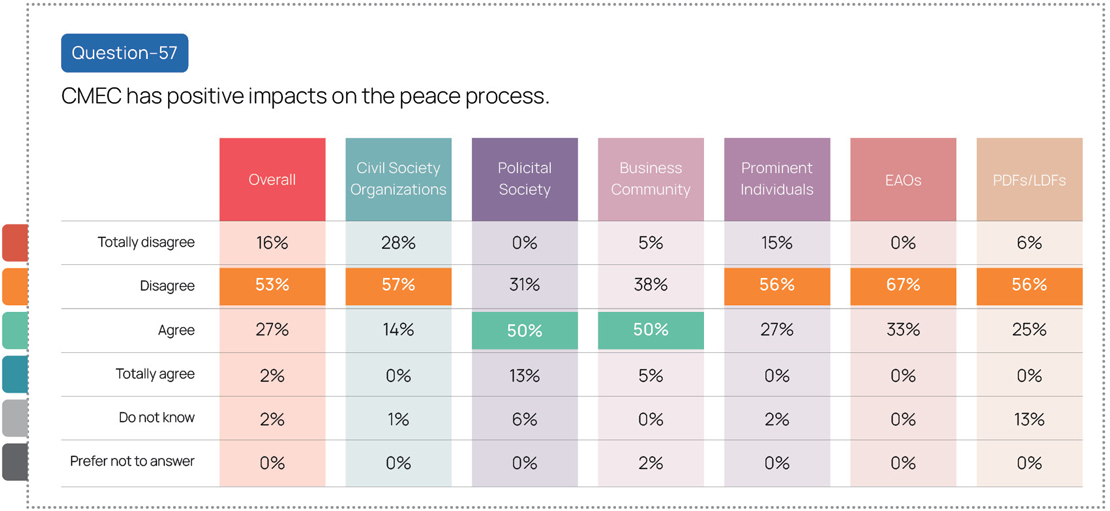
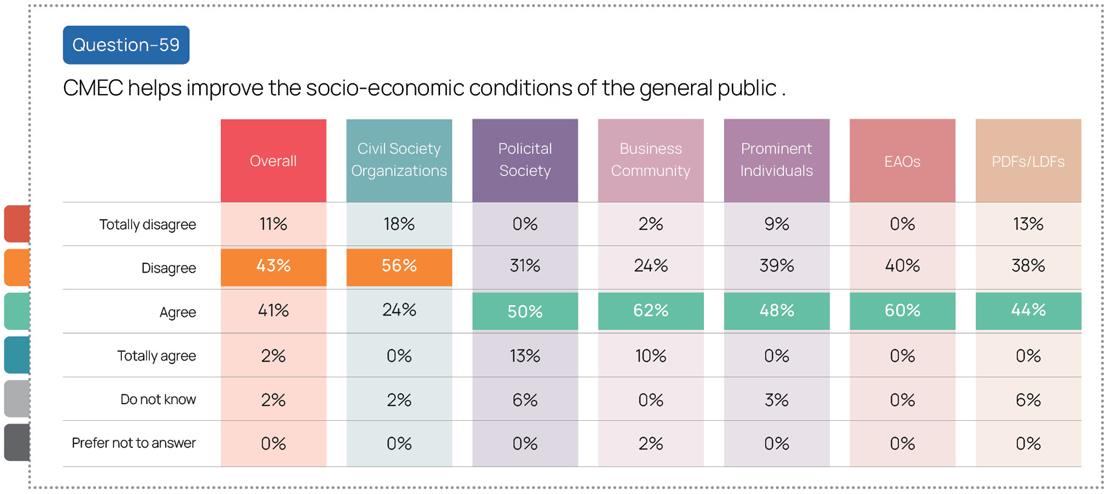
For survey questions No. 57 to 59, respondents were asked to what extent they agree or disagree with a series of statements regarding CMEC’s potential positive impacts on the peace process, economic development, socio-economic advancements, and potential exit from economic and political crises, using a four-point scale ranging from 1. Totally disagree to 4. Totally agree.

Question–60
Views on the impacts of the China–Myanmar Economic Corridor (CMEC)
For survey question No. 60, respondents were asked to what extent they agree or disagree
with a series of statements regarding CMEC’s potential positive impacts on the peace process, economic development, socio-economic advancements, and potential exit from economic and political crises, using a four-point scale ranging from 1. Totally disagree to 4. Totally agree.

Respondents were notably more skeptical about CMEC’s political impacts than its economic benefits. A strong majority (71 percent) disagreed that CMEC offers a solution to Myanmar’s economic and political crises, and 69 percent rejected the idea that it contributes to the peace process. Views were split on the positive impact on socio-economic livelihoods, with 54 percent disagreeing and 43 percent agreeing. In contrast, perceptions of CMEC’s economic contribution were more favorable. While still mixed, 61 percent agreed that CMEC supports economic development, compared to 37 percent who disagreed.
Analysis of the Survey Results
A closer look reveals that the majority of CSOs (85 percent), prominent figures (71 percent), EAOs (67 percent), and PDFs/LDFs (62 percent) disagreed that CMEC would positively impact the peace process. In contrast, a majority of respondents from the political society group (63 percent) and business community group (55 percent) believed it would. This divide suggests a significant perception gap between civil and resistance actors on the one hand, and institutional and economic elites on the other regarding CMEC’s role in promoting peace. A strong majority of respondents from the business community (91 percent), political society (75 percent), prominent individuals (66 percent), and PDFs/LDFs (56 percent) agreed that CMEC would contribute to Myanmar’s economic development. In contrast, opinions were more divided among EAOs and CSOs. While 53 percent of EAOs agreed and 47 percent disagreed, CSOs leaned slightly toward disagreement, with 52 percent rejecting the statement and 46 percent supporting it. Additionally, the majority of the business community group (72 percent), the political society group (63 percent), and EAOs (60 percent) agreed that CMEC would improve Myanmar people’s socio-economic livelihoods, whereas CSOs (74 percent) and PDFs/LDFs (51 percent) disagreed. A large majority of those from EAOs (93 percent), CSOs (76 percent), PDFs/LDFs (76 percent), prominent individuals (71 percent), business community (60 percent), and political society (50 percent) disagreed that CMEC would provide a solution to Myanmar’s economic and political crises, while the political society group (44 percent) and business community group (38 percent) weakly agreed.


Unless otherwise stated, responses of “Totally disagree” and “Disagree” were grouped under “Disagree,” while “Agree” and “Totally agree” were grouped under “Agree,” for the purpose of analysis.
Question–61
Views on the China–Myanmar Economic Corridor’s impacts on Myanmar’s society and environment
Respondents were asked to assess to what extent CMEC would affect the socio-environmental aspects in Myanmar, using a four-point scale ranging from 1. No negative impact at all to 4. Very high negative impact.

Regarding the socio-environmental impacts of the China–Myanmar Economic Corridor (CMEC), 88 percent of respondents perceived CMEC to have had a negative impact, while seven percent considered it to have had no negative impact. There were no considerable differences compared with the previous two years’ survey results.
Analysis of the Survey Results
Overall, all surveyed stakeholder groups in Myanmar felt that CMEC has a negative impact on Myanmar’s society and environment. Respondents from EAOs expressed the strongest concern with 100 percent, followed by CSOs (94 percent), PDFs/LDFs (87 percent), prominent individuals (85 percent), the business community (76 percent), and the political society group (75 percent).
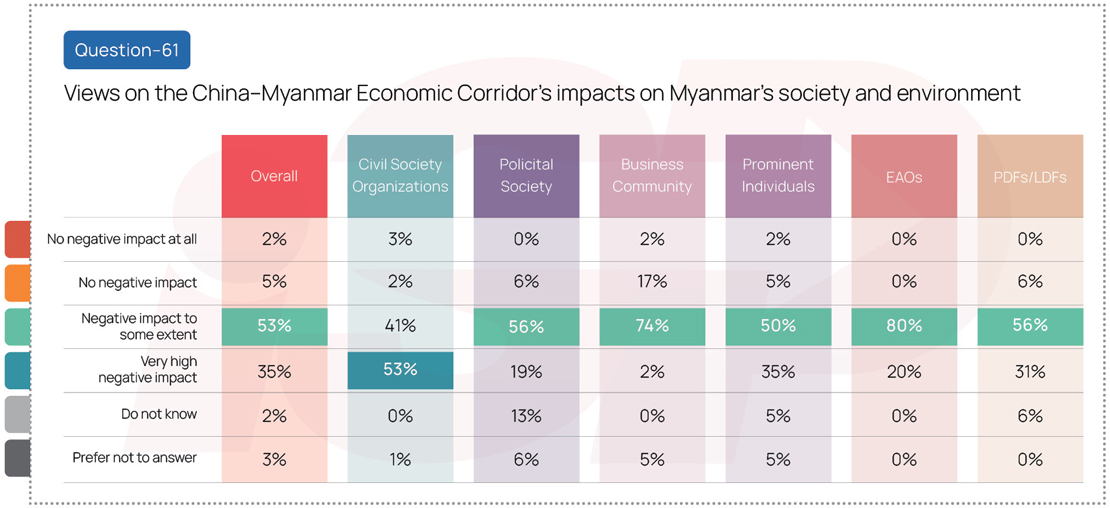
Unless otherwise stated, responses of “Very high negative impact” and “Negative impact to some extent” were grouped under “Negative impact,” while “No negative impact” and “No negative impact at all” were grouped under “No negative impact,” for the purpose of analysis.
Question–62
Engagement regarding the China–Myanmar Economic Corridor projects
For survey question No. 62, respondents were asked whether Chinese company officials engaged with the key stakeholders regarding the China–Myanmar Economic Corridor (CMEC) projects or not and if they were contacted, respondents were asked to select from two types of contact if applicable.

Regarding consultations related to the China–Myanmar Economic Corridor (CMEC), 82 percent of respondents reported that Chinese companies did not contact or engage with them at all. Eleven percent indicated that they were engaged directly by responsible personnel, while five percent stated that contact occurred through local authorities. Compared to previous surveys, the number of respondents reporting no engagement has increased annually.
Analysis of the Survey Results
The majority of respondent groups reported no contact from Chinese companies regarding CMEC projects. This was affirmed by CSOs (86 percent), prominent individuals (85 percent), PDFs/LDFs (81 percent), EAOs (80 percent), the business community (74 percent), and the political society group (69 percent). However, the political society group (25 percent), the business community (17 percent), and CSOs (10 percent) indicated that they were engaged directly by responsible personnel. Additionally, EAOs (20 percent) and PDFs/LDFs (13 percent) reported receiving contact through local authorities. Notably, 13 percent of PDFs/LDFs stated they were unaware of any contact.

Question–63
What was the main purpose of engagement conducted by Chinese companies involved in the China–Myanmar Economic Corridor?
For survey question No. 63, respondents were asked to identify the purposes of engagement by Chinese companies implementing CMEC, with the option to select multiple purposes. This question was newly introduced in the 2024 survey.

Regarding engagement related to CMEC, half of respondents said Chinese companies sought to ensure the continuation of existing projects by requesting cooperation. One-fourth believed the purpose was to warn local actors against disrupting or damaging projects, while one-fifth said the goal was to propose new trade or investment opportunities. Additionally, 30 percent cited other reasons, including explaining project benefits, building local support, and encouraging academic institutions to clarify that the projects do not represent a debt trap.
Analysis of the Survey Results
Respondent groups reported varying perceptions of the purposes behind these engagements. Notably, 100 percent of PDFs/LDFs said the companies warned against disrupting the projects. Meanwhile, CSOs (67 percent), EAOs (67 percent), and the business community (50 percent) pointed to efforts to ensure project continuity. The political society (75 percent) and prominent public individuals (75 percent) cited other purposes, including public outreach, local engagement, and reputational management in response to debt-related concerns.

Question–64
Perceived status of China–Myanmar Economic Corridor project implementation
Respondents were asked about their perceptions of the implementation status of CMEC between the State Administration Council (SAC) and China following the 2021 coup, with the option to select more than one response if applicable.

Regarding the implementation status of CMEC projects in the post-coup period, 62 percent of respondents perceived that CMEC was being partially implemented. Additionally, 28 percent indicated that the project’s implementation had been halted, while five percent viewed it as being implemented rapidly. Eight percent of respondents stated they did not know CMEC’s current implementation status. Compared to the 2023 survey, there were slight changes: respondents reporting halted implementation increased by 10 percentage points, while those noting partial implementation decreased by four points, and those perceiving rapid implementation decreased by seven points.
Analysis of the Survey Results
In examining responses from the six communities regarding the status of CMEC implementation, the business community (55 percent), political society (50 percent), and EAOs (47 percent) primarily indicated halted implementation. Conversely, PDFs/LDFs (75 percent), prominent individuals (71 percent), and CSOs (70 percent) perceived partial implementation. Fewer than 10 percent of respondents across all groups reported rapid implementation. Notably, EAOs (20 percent), PDFs/LDFs (13 percent), and the political society group (13 percent) stated they did not know the implementation status.

Question–65
Should the China–Myanmar Economic Corridor be implemented during Myanmar’s current political crisis?
For survey question No. 65, respondents were asked whether they agree or disagree with the implementation of CMEC by China during Myanmar’s current political crisis.

The survey revealed significant opposition among Myanmar’s key stakeholders to the implementation of CMEC during the ongoing political crisis. The majority of respondents, 77 percent, expressed disagreement with the implementation, while 19 percent indicated agreement. Compared to the 2023 survey, disagreement increased by six percentage points, and agreement decreased by four points.
Analysis of the Survey Results
Perceptions of the potential implementation of CMEC amid Myanmar’s ongoing political crisis reveal varied opinions among different groups. Strong opposition was observed among CSOs (90 percent), PDFs/LDFs (88 percent), prominent individuals (76 percent), and EAOs (73 percent). In contrast, opinions within the political society and business community were evenly split. While a slight majority of the business community (57 percent) and political society group (50 percent) opposed implementation, a significant minority—43 percent and 44 percent, respectively—expressed support.

Question–66
Reasons for agreement with the implementation of China–Myanmar Economic Corridor projects
For survey question No. 66, respondents who agreed with the implementation of CMEC were asked to select up to three reasons for their agreement. This question was newly introduced in the current survey.

The survey revealed that the most common reason for supporting the implementation of CMEC was its potential to promote economic growth and infrastructure development, cited by 68 percent of respondents. The second most common reason was that CMEC was a way to help address Myanmar’s current economic crises, chosen by 54 percent. The third most common reason given, at 50 percent, was that CMEC could increase market access to China and other regional countries.
Analysis of the Survey Results
Reasons for supporting CMEC implementation varied across the six stakeholder groups. The potential for economic and infrastructure development was the most widely cited reason, reported by 100 percent of PDFs/LDFs, 89 percent of the business community, 80 percent of the prominent individuals group, and 75 percent of EAOs. CMEC as a solution to the current economic crisis was endorsed by 100 percent of PDFs/LDFs, followed by 70 percent of the prominent individuals group. The opportunity for increased market access was highlighted by 75 percent of EAOs, 67 percent of the business community, and 57 percent of the political society group. The prospect of improving socio-economic livelihoods was selected by 100 percent of PDFs/LDFs, 71 percent of political actors, and 50 percent of prominent individuals. Notably, PDFs/LDFs unanimously supported CMEC for its role in economic development, crisis mitigation, and livelihood improvement.

Question–67
Reasons for disagreement with the implementation of China–Myanmar Economic Corridor projects
For survey question No. 67, respondents who disagreed with the implementation of CMEC were asked to select up to three reasons for their disagreement. This question was newly introduced in the current survey.

The most common reason for disapproval of CMEC, selected by 56 percent, was that it could harm local livelihoods and the environment. Fifty-two percent pointed to rising Chinese political influence over Myanmar, while 41 percent were concerned about geopolitical tensions threatening national stability. Additionally, 38 percent feared a debt trap, and 35 percent noted the risk of economic overdependence on China.
Analysis of the Survey Results
Views varied across stakeholder groups on their top three reasons for not supporting CMEC implementation. Concerns over harm to livelihoods and the environment were most frequently cited by political society (63 percent), CSOs (62 percent), and PDFs/LDFs (57 percent). Worries about Chinese political influence were highest among political actors (75 percent), followed by EAOs (55 percent) and CSOs (52 percent). Geopolitical instability was highlighted by the business community (54 percent), PDFs/LDFs (50 percent), and political society (50 percent). The debt trap concern was noted by PDFs/LDFs (50 percent), political society (50 percent), and prominent individuals (44 percent).

- Myanmar’s Key Stakeholders and their Perceptions of Sino-Myanmar Relations – A Survey (2024)
- Key Findings
- General Perceptions of China
- Perceptions of China’s Role in Myanmar’s Political Crisis
- Perceptions of the Role of China in Myanmar’s Peace Processes
- Perceptions of China–Myanmar Economic Relations
-
Perceptions of China–Myanmar Economic Corridor (CMEC) Projects Currently reading
- Perceptions of China’s Regional Integration Plans Through Myanmar
- Perceptions of China’s Soft Power
- Perceptions of the Use of Chinese Technology