


Photo-AFP
“Myanmar’s Key Stakeholders and their Perceptions of Sino-Myanmar Relations – A Survey (2024),” was published in August, 2025, as a translation of the original Burmese version published in June, 2025. This survey is a part of research conducted by the ISP-Myanmar’s China Studies. ISP-Myanmar has been conducting this annual survey since 2022, making the 2024 survey the third iteration.
Question–1
Is China a good neighbor for Myanmar?
Respondents were asked whether China is a good neighbor for Myanmar or not by providing a set of responses based on a four-point scale- ( 1) Not good at all, (2) Not a good neighbor, (3) Good neighbor, and (4) A very good neighbor.

Negative opinions of China among Myanmar’s key stakeholders have risen compared to the results of the previous two years. A majority of key stakeholders surveyed (68 percent) think that China is not a good neighbor. On the other hand, 30 percent considered it a good neighbor. Negative sentiment has grown steadily, rising by 14 percentage points since the 2023 survey and 13 points since 2022. In contrast, those who see China as a good neighbor—whether very good or simply good—have declined by 12 percentage points compared to 2023 and 10 percentage points compared to 2022.
Analysis of the Survey Results
When comparing results across different policy communities, CSOs showed the highest negative attitude, with 83 percent perceiving China as “not a good neighbor.” Similarly, 73 percent of prominent figures, 63 percent of PDFs/LDFs, and 53 percent of EAOs shared this view. However, 63 percent of the political society and 60 percent of the business community considered China a good neighbor.

Unless otherwise stated, responses of ‘Not good at all’ and ‘Not a good neighbor’ are grouped together as ‘Not a good neighbor,’ while ‘A good neighbor’ and ‘A very good neighbor’ are grouped as ‘A good neighbor’ for the purpose of analysis.
Question–2
What is the main challenge Myanmar faces in its relations with China?
Respondents were asked to select only one option from a list of challenges that Myanmar faces in its relations with China.

Myanmar key stakeholders’ views on the main challenge Myanmar faces in its bilateral relations with China have changed since last year. This year, nearly half of the respondents—46 percent—picked “China’s interference in Myanmar’s armed conflict and security sector” as the most pressing challenge in bilateral relations. In past years, “China’s interference in Myanmar’s armed conflict” and “China’s influence in the security sector” were asked as separate questions. In the 2023 survey, 21 percent of respondents chose “China’s interference in Myanmar’s armed conflict” while six percent chose “China’s influence in the security sector.” In the 2022 survey, 19 percent selected “China’s interference in Myanmar’s armed conflict” while four percent chose “China’s influence in the security sector.” In this year’s survey, answers relating to geopolitical influence ranked second at 32 percent, with economic influence ranking third at 17 percent —both down sharply by 21 and 22 percentage points respectively compared to 2023 and 2022.
Analysis of the Survey Results
In analyzing the responses from the six surveyed community groups, “China’s interference in Myanmar’s armed conflict and security sector” were selected by prominent figures at 52 percent and CSOs at 50 percent, the highest compared to other groups’ answers. EAOs at 47 percent and PDFs/LDFs at 44 percent selected both “China’s interference in Myanmar’s armed conflict and security sector” and “China’s geopolitical influence.” Meanwhile, half of the political society group chose “China’s geopolitical influence” as the main challenge.

Question–3
What is the main benefit Myanmar gains from its relations with China?
Respondents were asked to select only one option from a list of possible benefits Myanmar gains from its relations with China.

Foreign direct investment was seen as the main benefit that Myanmar gains from China, with 30 percent of key stakeholders selecting this option. Market access followed closely at 28 percent, while 13 percent said there were no benefits at all. This marks a shift of opinions from the 2022 and 2023 surveys, when market access topped the list at 37 percent in both years, a nine percentage point decline this year.
Analysis of the Survey Results
In comparing responses across the six surveyed stakeholder groups, most EAOs and CSOs identified “foreign direct investment” as the main benefit Myanmar gains from its relationship with China. Specifically, 47 percent of EAO and 35 percent of CSO respondents selected this option. Similarly, 33 percent of business community respondents and 31 percent of political society respondents also viewed foreign direct investment as the main benefit. Among those who cited “market access” as the key benefit, PDFs/LDFs has the largest share at 38 percent, followed by 33 percent of business community respondents and 26 percent of prominent public figures.

Questions–4 to 7
How dependent is Myanmar on China?
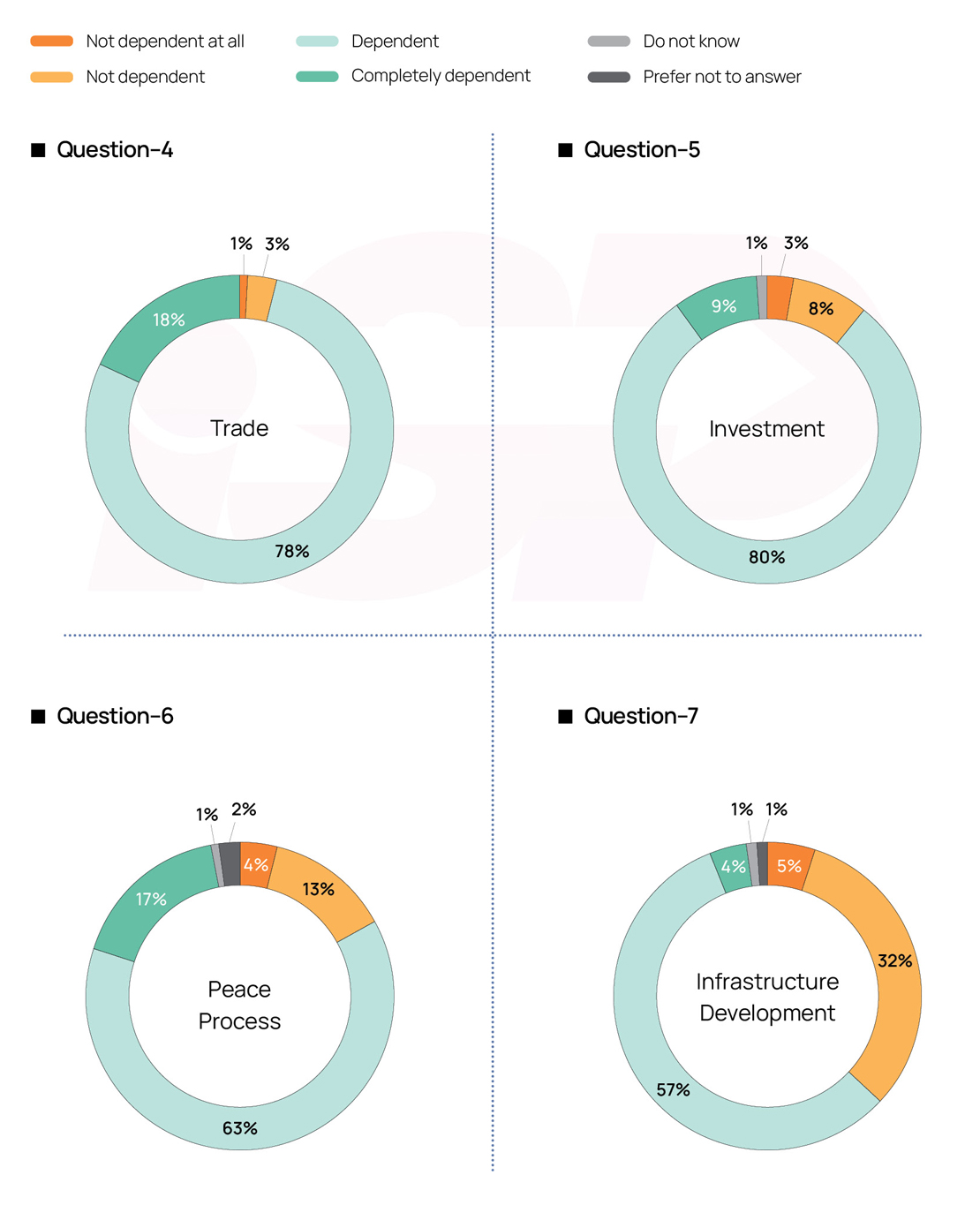
For survey questions No. 4 to 7, respondents were asked to rate their views on the level of Myanmar’s dependence on China in specific key areas. The options were provided on a four-point scale (from 1. Not dependent at all to 4. Completely dependent).
Questions–8 to 11
How dependent is Myanmar on China?
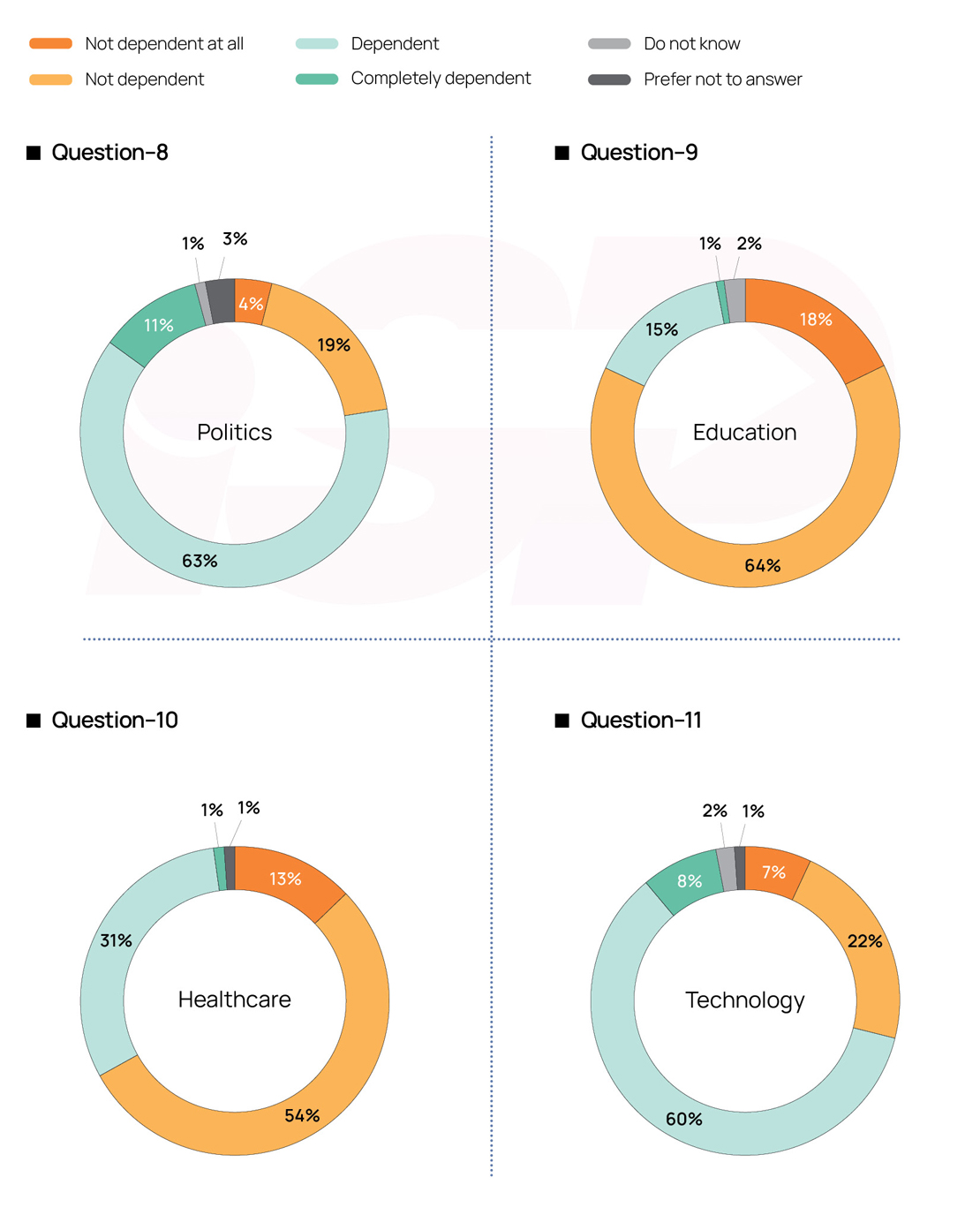
For survey questions No. 8 to 11, respondents were asked to rate their views on the level of Myanmar’s dependence on China in specific key areas. The options were provided on a four-point scale (from 1. Not dependent at all to 4. Completely dependent).
Questions–12 and 13
How dependent is Myanmar on China?
For survey questions No. 12 and 13, respondents were asked to rate their views on the level of Myanmar’s dependence on China in specific key areas. The options were provided on a four-point scale (from 1. Not dependent at all to 4. Completely dependent).

Survey respondents overwhelmingly viewed that Myanmar remains heavily dependent on China in various areas except education and healthcare. In particular, respondents indicated that Myanmar is dependent on China for trade (96 percent), investment (89 percent), diplomacy (83 percent), the peace process (80 percent), and politics (74 percent). These figures closely mirror last year’s findings, with the top three categories—trade, investment, and diplomacy—retaining their rankings. However, perceptions of dependency in security and politics declined by 10 and 5 percentage points respectively.
Analysis of the Survey Results
In analyzing responses from the six communities surveyed, all communities agreed that Myanmar is dependent on China in terms of trade. Notably, all respondents from EAOs and the political community shared this view. Regarding politics, the peace process, investment, technology, and diplomacy, all communities shared similar views, agreeing that Myanmar is dependent on China for these sectors. However, the groups presented differing views on infrastructure development, healthcare and security. Over half of EAO respondents (53 percent), the highest among the six communities, viewed that Myanmar does not depend on China for infrastructure development. In the healthcare sector, while other communities indicated no dependency on China, 50 percent of PDF respondents reported dependency. While all other communities indicated dependency on China for security, 75 percent of PDF respondents stated that Myanmar does not depend on China.
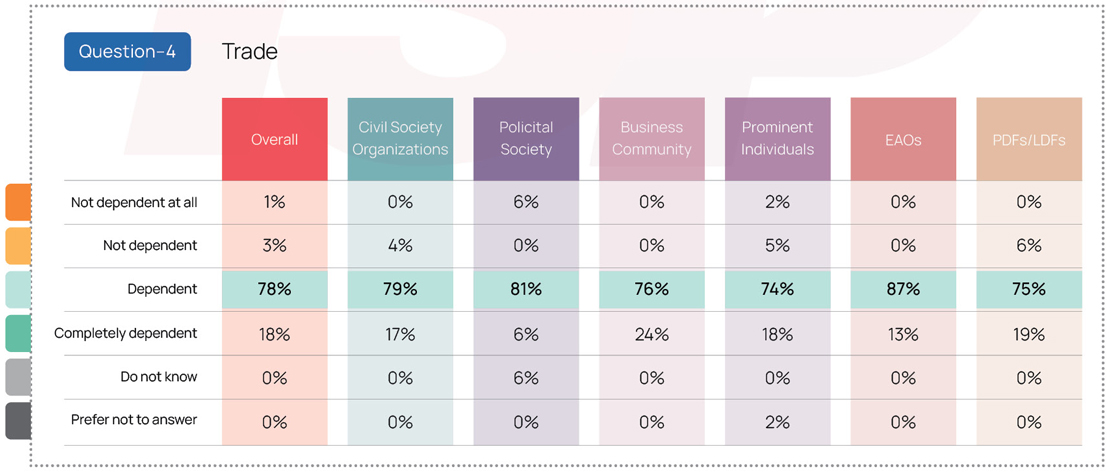

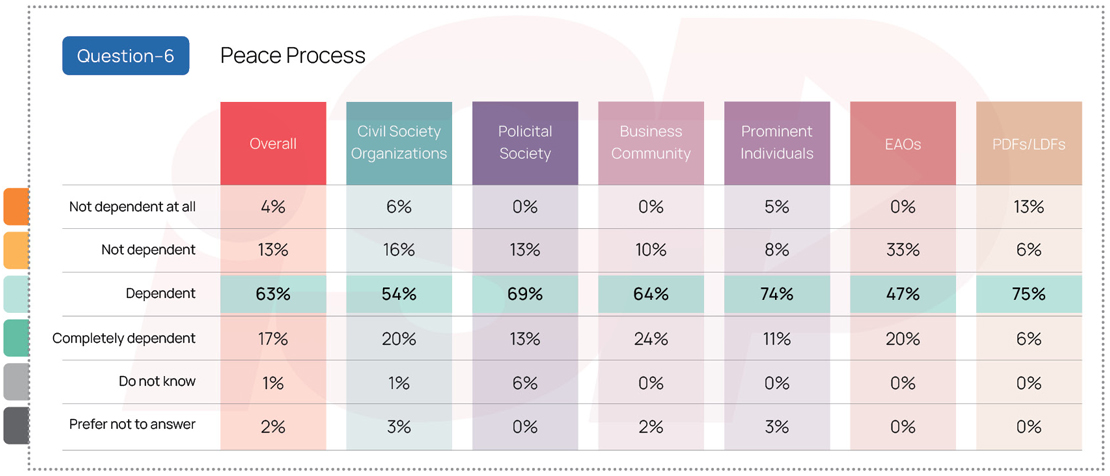


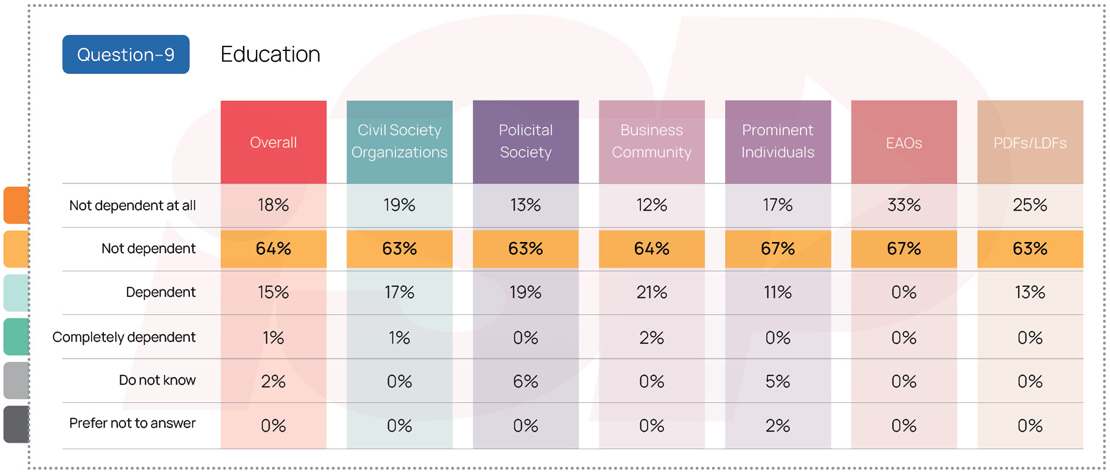
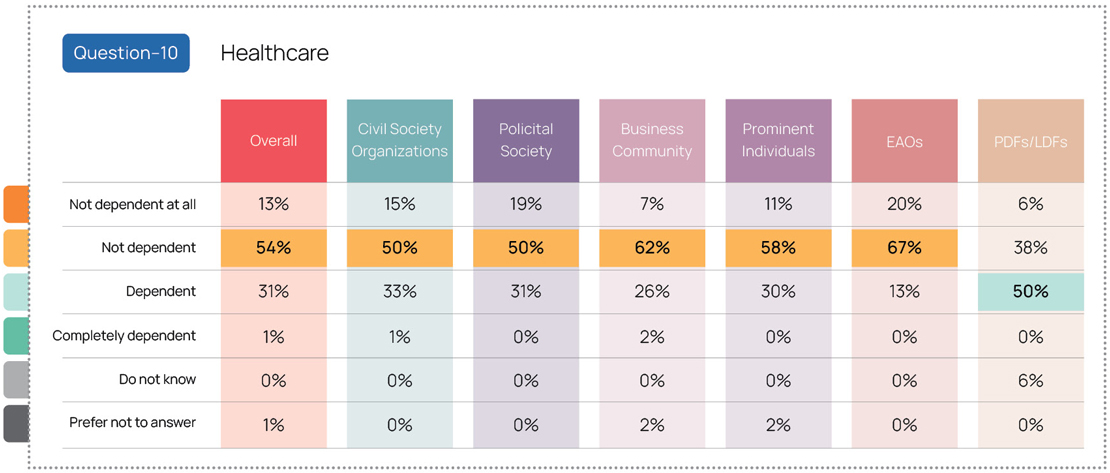
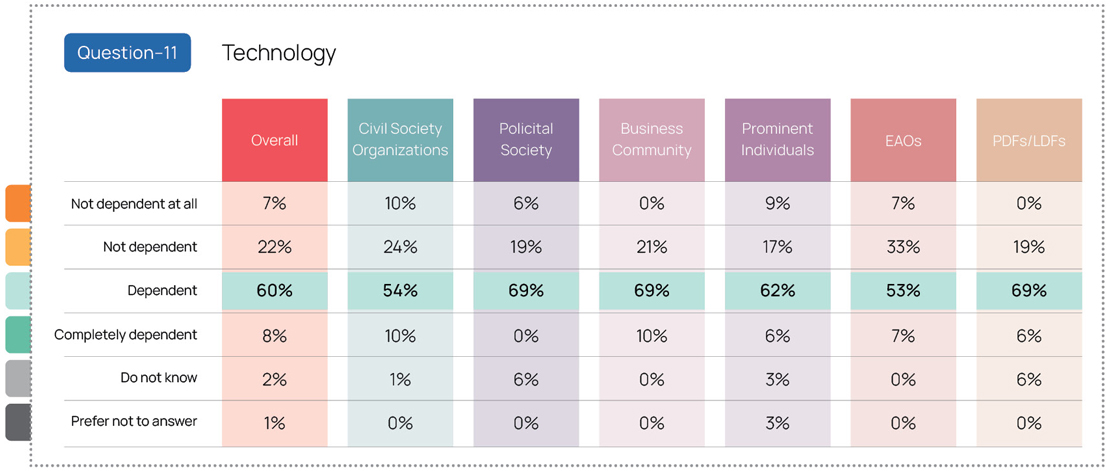
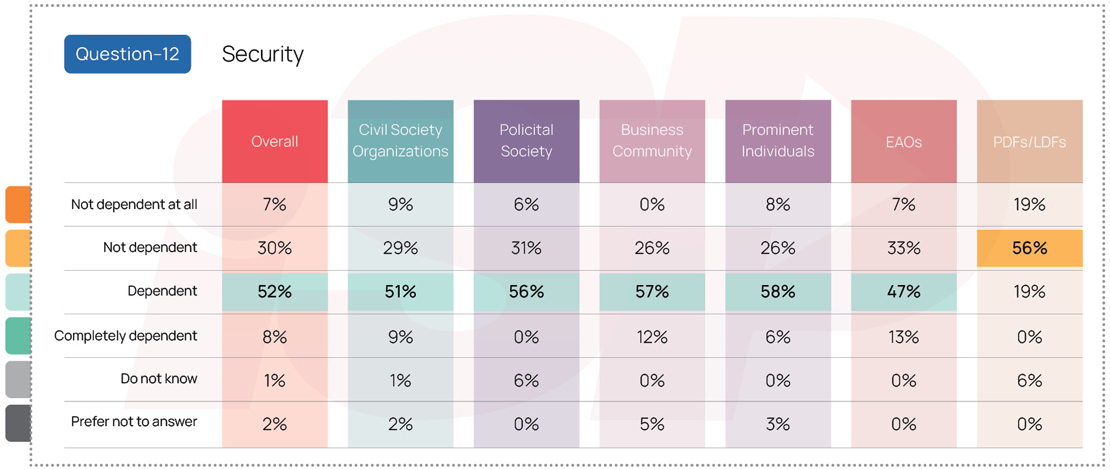

Unless otherwise stated, responses of ‘Not dependent at all’ and ‘Not dependent’ are grouped together as ‘Not dependent,’ while ‘Dependent’ and ‘Completely dependent’ are grouped as ‘Dependent’ for the purpose of analysis.
Question–14
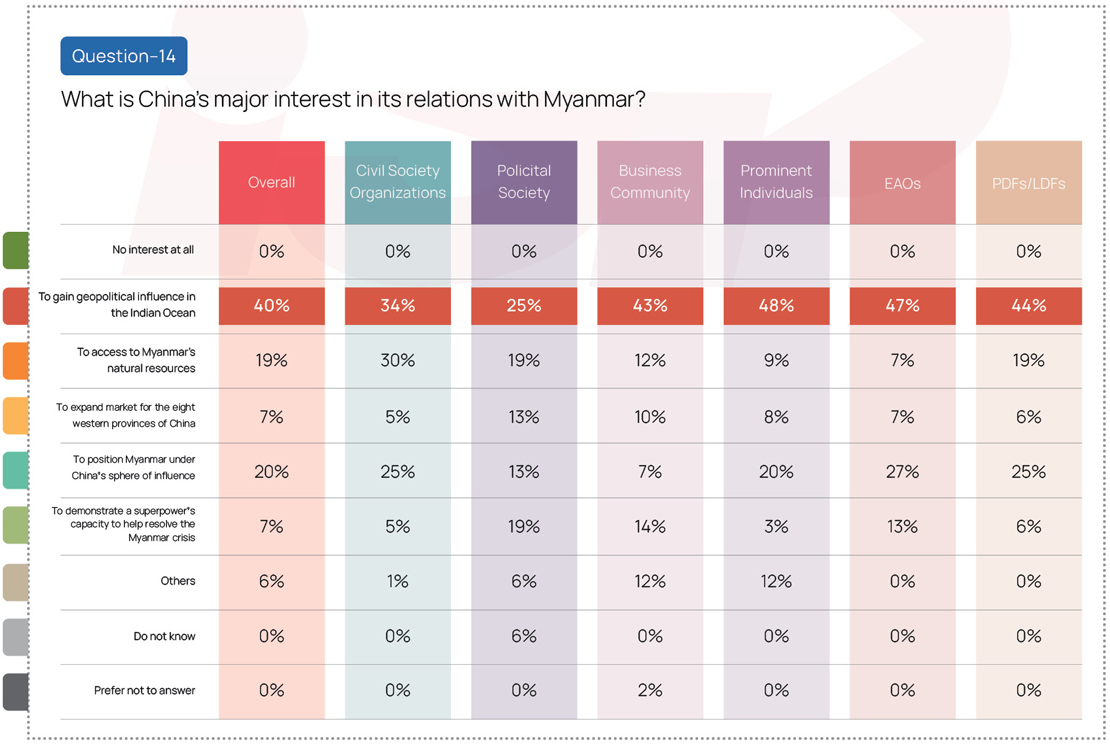
What is China’s major interest in its relations with Myanmar?
From the list of responses regarding China’s key interest in its relations with Myanmar respondents were asked to select only one option. The choices “Indian Ocean access for Yunnan Province,” “Forming an alliance with ASEAN,” and “Expansion of the market for China’s basic industrial products,” which were included in previous surveys, were not included in this round. Meanwhile, “demonstrating a superpower’s capacity to help resolve the Myanmar crisis” and “market expansion for the eight western provinces of China” were newly added in this survey.

Among Myanmar’s key stakeholders, to gain geopolitical influence in the Indian Ocean was viewed as China’s primary interest in its relationship with Myanmar, with 40 percent selecting this option. This was followed by “to position Myanmar under China’s sphere of influence” (20 percent) and “to access to Myanmar’s natural resources” (19 percent). Geopolitical influence in the Indian Ocean remains unchanged as the top response over the 2022, 2023 and 2024 surveys. However, the share of respondents who chose China’s intent to position Myanmar within its sphere of influence rose by seven percentage points this year.
Analysis of the Survey Results
The biggest proportion of all policy communities agreed that China’s interest in Myanmar is to gain geopolitical influence in the Indian Ocean. This perspective was shared among 48 percent of prominent figures, 47 percent of EAOs, 44 percent of PDFs, 43 percent of business communities, and 34 percent of CSOs. For the response “to position Myanmar under China’s sphere of influence,” 27 percent of EAOs—the highest among the six groups—indicated agreement. “To access to Myanmar’s natural resources” was most frequently cited by CSOs, at 30 percent. “To demonstrate capability as a superpower to resolve the Myanmar crisis” was cited by the political society the most (19 percent) compared to other groups.
Question–15
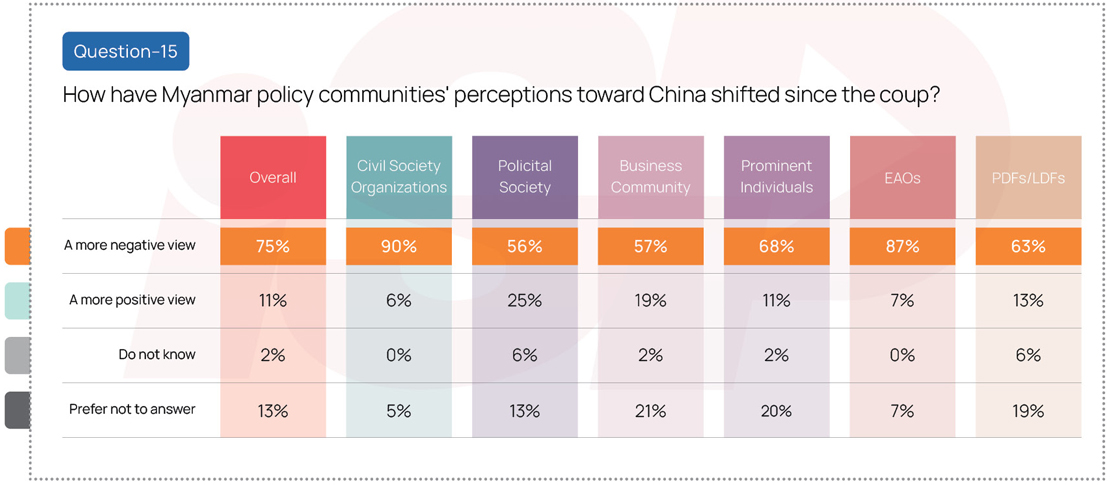
How have Myanmar policy communities’ perceptions toward China shifted since the coup?
Respondents were asked, “Compared to the period before the 2021 coup, have you developed a more positive view of China, or a more negative view?” The response option “no change,” which had been included in previous surveys, was excluded in this year’s survey.

Since the 2021 coup, a clear majority—75 percent—said they now hold a more negative view of China. Only 11 percent reported a more positive view, while 13 percent avoided answering this question. The proportion of those expressing a more negative sentiment has risen sharply—by 41 percentage points since 2022 and 47 points since 2023. Notably, however, those reporting a more positive view also increased, though marginally: up nine points from 2022 and five from 2023. In previous surveys, a majority had reported “no change” in their perception of China—64 percent in 2023 and 59 percent in 2022.
Analysis of the Survey Results
A more negative view of China was prevalent across all key stakeholder groups, with CSOs and EAOs reporting the highest percentage, at 90 percent and 87 percent, respectively. Among the remaining groups, 68 percent of prominent figures and 63 percent of PDFs/LDFs held a more negative view. For “a more positive view,” the political society community had the highest response rate at 25 percent. The business community had the highest rate of respondents choosing “prefer not to answer,” at 21 percent.
- Myanmar’s Key Stakeholders and their Perceptions of Sino-Myanmar Relations – A Survey (2024)
- Key Findings
-
General Perceptions of China Currently reading
- Perceptions of China’s Role in Myanmar’s Political Crisis
- Perceptions of the Role of China in Myanmar’s Peace Processes
- Perceptions of China–Myanmar Economic Relations
- Perceptions of China–Myanmar Economic Corridor (CMEC) Projects
- Perceptions of China’s Regional Integration Plans Through Myanmar
- Perceptions of China’s Soft Power
- Perceptions of the Use of Chinese Technology