
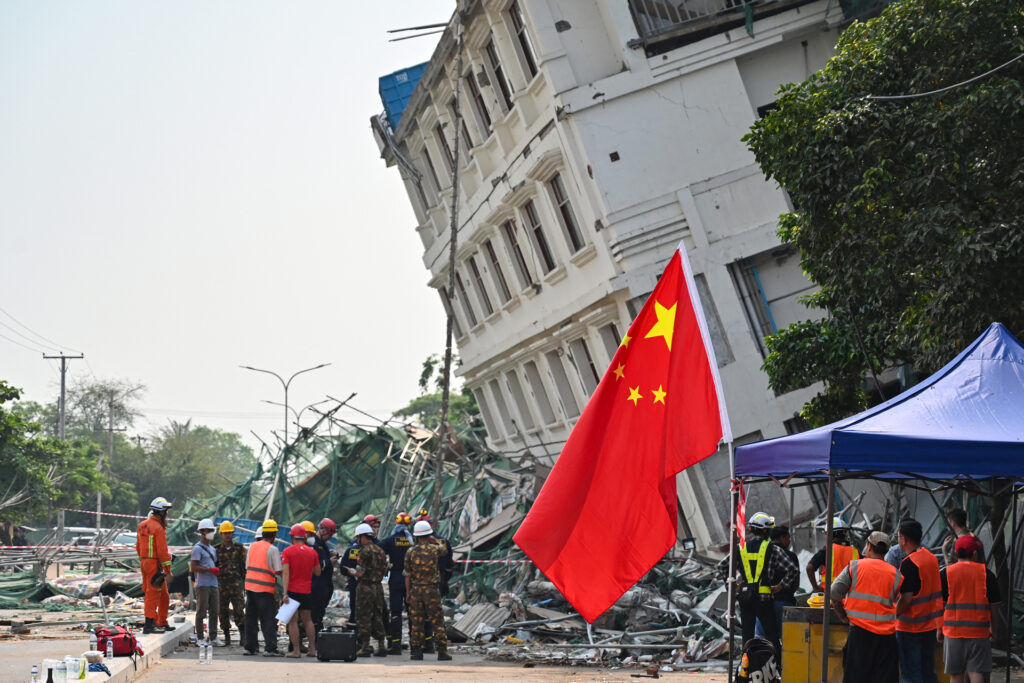

Photo-AFP
“Myanmar’s Key Stakeholders and their Perceptions of Sino-Myanmar Relations – A Survey (2024),” was published in August, 2025, as a translation of the original Burmese version published in June, 2025. This survey is a part of research conducted by the ISP-Myanmar’s China Studies. ISP-Myanmar has been conducting this annual survey since 2022, making the 2024 survey the third iteration.
About the Survey
Since 2022, the Institute of Strategy and Policy-Myanmar (ISP-Myanmar) has been conducting an annual survey titled “Myanmar’s Key Stakeholders and Their Perceptions of Sino-Myanmar Relations.” The 2024 survey, which marks the third iteration, aims to analyze how key figures within Myanmar’s policy community from various sectors perceive the fundamental factors shaping Sino-Myanmar relations. Through the survey findings, ISP-Myanmar explores gaps between perceptions of different groups and connections within these dynamics. This year’s survey includes 92 questions, divided into eight sections: (1) general perceptions of China, (2) perceptions of the role of China in Myanmar’s political crisis, (3) perceptions of the role of China in Myanmar’s peace processes, (4) perceptions of Sino-Myanmar economic relations, (5) perceptions of China-Myanmar Economic Corridor (CMEC) projects, (6) perceptions of China’s regional integration plans through Myanmar, (7) perceptions of China’s soft power, and (8)perceptions of the use of Chinese technology.
Survey respondents consisted of six key stakeholder groups: (1) the political community (2) the business community (3) civil society organizations (CSOs) (4) prominent individuals, including scholars, activists and pundits who are knowledgeable about China’s political, economic, and international affairs (5) leaders and members of ethnic armed organizations (EAOs) (6) leaders and members of the People’s Defense Forces (PDFs) and Local Defense Forces (LDFs), which emerged during the Spring Revolution and operate in areas where Chinese investments are located.

A distinctive feature of this survey is the inclusion of questions exploring Myanmar key stakeholders’ perceptions on China’s stance, positions, and policies regarding conflict resolution in Myanmar. The survey aimed to reach 300 individuals across six stakeholder groups and successfully collected responses from 260 participants, including 193 male, 64 female, and three individuals who identified as other genders. This represents an increase of 10 respondents compared to the 2023 survey and 45 more than the 2022 survey, with female participation also rising steadily each year. To ensure clarity and ease of interpretation, the numerical data in this survey have been rounded to the nearest whole number. As a result, percentages may not total 100 percent. This does not affect the overall reliability, validity, or accuracy of the survey results. The survey received technical support from the People’s Alliance for Credible Elections (PACE). Detailed methodologies and topics covered can be explored in the appendices.
To make sense of the survey responses from Myanmar’s six policy communities, it is essential to consider the broader political and conflict dynamics context during the data collection period. The Three Brotherhood Alliance (3BHA) resumed the second phase of Operation 1027 a few months before the survey commenced. Prior to this, the 3BHA had already overrun 240 military outposts and key border trade stations held by the State Administration Council (SAC), dealing a significant blow to the regime. In response, Beijing brokered ceasefire talks between the SAC and 3BHA in Kunming, Yunnan Province—dubbed the “Haigeng Talks” after the hotel where the talks took place. These talks reflected China’s strategy of “conflict de-escalation through economic incentives.” The Haigeng Agreement produced a temporary ceasefire in northern Shan State, effective January 11, 2024. In a parallel diplomatic move, Chinese Foreign Minister Wang Yi visited Naypyitaw on August 14, meeting SAC leadership, former Senior General Than Shwe and former President Thein Sein.
The Haigeng Talks period marked a turning point in China’s diplomatic strategy toward Myanmar. Foreign Minister Wang Yi also laid out three “bottom lines” for Myanmar: the country must not descend into civil war, sever ties with ASEAN, or fall under the sway of foreign powers. Beijing also reaffirmed support for elections as a political exit for the SAC. Soon after, China exerted pressure on both the SAC and the Myanmar National Democratic Alliance Army (MNDAA) to restore a ceasefire, paving the way for the regime’s reoccupation of Lashio, which had previously been controlled by the MNDAA. During the survey period, October 2024, meeting records between Deng Xijun, China’s Special Envoy to Myanmar, and the United Wa State Army (UWSA) were also leaked. Later, following the powerful earthquake in Mandalay and Sagaing on March 28, 2025, China provided swift humanitarian assistance. These developments form the backdrop against which Myanmar’s policy community has assessed China’s role—adding critical nuances to the survey findings.
Executive Summary
The 2024 survey reveals a significant rise in negative perceptions of China within Myanmar’s policy community. Most notably, perceptions of China as “not a good neighbor” have increased significantly. This year’s most striking finding is a shift in concern: where economic dominance once topped the list, a majority of respondents now said China’s interference in Myanmar’s internal armed conflicts and security sector as the greatest challenge in bilateral relations.
Among Ethnic Armed Organizations (EAOs), there is a prevalent belief that China seeks to position Myanmar as a client state. Pessimism has also grown regarding China’s involvement in Myanmar’s peace process and its outcomes. Many respondents view China’s policies on resolving Myanmar’s crisis regarding the Three Bottom Lines as impractical, with a rising number believing that China is actively interfering in Myanmar’s affairs and prefers an authoritarian governance system for the country.
Additionally, there is widespread disapproval of the implementation of China-Myanmar Economic Corridor (CMEC) projects. Findings indicated that Chinese companies have reached out to EAOs to ensure the continued operation of these projects. At the same time, China has also contacted People’s Defense Forces and Local Defense Forces (PDFs/LDFs) in attempts to safeguard China-backed ventures. Regarding regional integration initiatives, awareness remains low—most respondents are unfamiliar with these projects, except for the Lancang-Mekong Cooperation (LMC). Additionally, China’s economic development model, ‘Democracy with Chinese Characteristics’, governance model, and related systems are increasingly disfavored.
-
Myanmar’s Key Stakeholders and their Perceptions of Sino-Myanmar Relations – A Survey (2024) Currently reading
- Key Findings
- General Perceptions of China
- Perceptions of China’s Role in Myanmar’s Political Crisis
- Perceptions of the Role of China in Myanmar’s Peace Processes
- Perceptions of China–Myanmar Economic Relations
- Perceptions of China–Myanmar Economic Corridor (CMEC) Projects
- Perceptions of China’s Regional Integration Plans Through Myanmar
- Perceptions of China’s Soft Power
- Perceptions of the Use of Chinese Technology
Appendix
Survey Methodology
The survey conducted by ISP-Myanmar employed a quantitative research methodology implemented in four stages. The first stage involved preliminary preparations for the survey and data analysis, including designing the survey, setting a detailed timeline, contacting potential participants to explain about the survey, encouraging participation, and verifying the accuracy of participants’ information.
The second stage included sampling key individuals for the research, confirming the survey methodology (sampling frame and survey method development), preparing and editing questions. The questions were reviewed to analyze changes between findings of the two previous surveys. Additionally, based on the evolving context of China-Myanmar relations, new questions were added, and some existing questions were removed. Furthermore, guidelines for supervisors and enumerators were drafted, security protocols were established, enumerators were selected, and training sessions for enumerators were conducted.
The third stage involved conducting interviews with individuals designated as sample groups for research analysis. The fourth stage encompassed data entry, documentation, analysis, and report writing. As in the previous year, ISP-Myanmar and the People’s Alliance for Credible Elections (PACE) collaborated on preliminary preparations, survey design, methodology confirmation, objective setting and analysis methods, question preparation, sampling, and conducting interviews with targeted individuals. Prior to the survey, discussions were held with relevant experts to ensure the sampling criteria were met, and meetings were conducted with targeted groups. Measures were taken to ensure reliability and validity by adhering to necessary standards. A pilot study was conducted with at least five individuals meeting the criteria, and their feedback was collected.
Given the survey’s primary objective, respondents needed to have a certain level of awareness of China-Myanmar relations. As random sampling was not feasible, purposive sampling was used to select participants based on their leadership and policy influence on China-Myanmar relations.
ISP-Myanmar categorized respondents into six communities based on specific criteria: (1) political society, including political parties and politicians; (2) CSOs; (3) business community; (4) EAOs; (5) prominent individuals, such as scholars, professionals, activists, and influential social or religious figures; and (6) leaders of armed groups based in areas with Chinese projects, specifically groups that emerged during the Spring Revolution.
To build baseline data, ISP-Myanmar gathered information from the websites of the Union Election Commission (UEC) and the Union of Myanmar Federation of Chambers of Commerce and Industry (UMFCCI). Additionally, preliminary discussions were held with leaders from various communities, CSOs in Myanmar and Thailand, EAOs, and PDFs/LDFs, and lists of prospective respondents were compiled. The expertise, knowledge, engagement, policy influence, and geopolitical significance of individuals and organizations in China-Myanmar relations were assessed with experts’ recommendations. This data was
updated and verified two months before the survey.
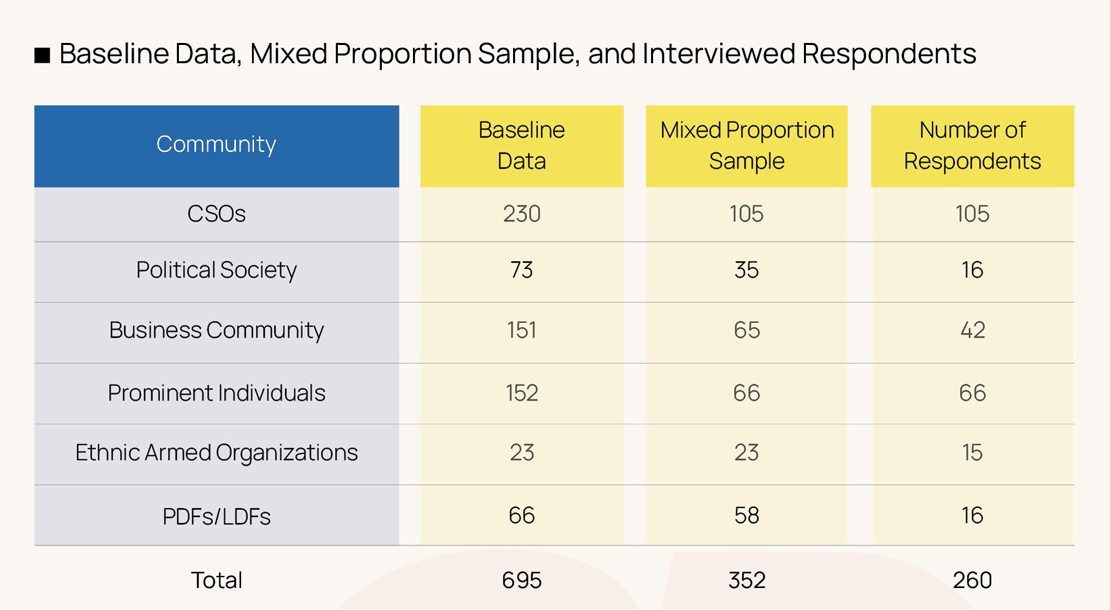
In compiling the list for the political community, political parties that won seats in various assemblies (Hluttaw) in the 2015 and 2020 elections and parties that are active in Kachin State, northern Shan State, Mandalay Region, Magway Region, and Rakhine State—key areas for the China-Myanmar Economic Corridor (CMEC)—were selected and designated as potential respondents. However, the State Administration Council (SAC) revised and enacted a new Political Parties Registration Law, resulting in many political parties that had won seats in the 2020 election not re-registering. For this survey, a total of 73 political leaders from these political parties, including those who are vocal about CMEC projects, were identified and included in the list.
The team also identified 230 individuals from CSOs that are: 1) working on research projects related to Sino–Myanmar relations, 2) monitoring Chinese-financed projects and their impacts on environmental and land issues, and 3) supporting the rights of local communities. The research team also identified a total of 151 union and state level business community members who are involved in China-related investment and trade projects, including those directly participating in CMEC. This list was based on data received from the Union of Myanmar Federation of Chambers of Commerce and Industry (UMFCCI).
The survey team also identified 152 individuals working on research related to Sino–Myanmar relations, well-known scholars and experts who can influence policy issues, activists, leaders of EAOs and influential persons from social and religious groups.
The list of relevant EAOs include solely those with ethnic affiliations and those that have engaged with previous governments in either formal or informal capacities. A total of 23 groups were identified.
Similarly, in the process of identifying newly emerged armed groups like PDFs/LDFs, the relevant PDFs/LDFs list includes groups that are operating in regions where Chinese investments were located. Additionally, the team considered the size of their forces, selecting groups with 100 or more members, as well as groups designated as “active” by ISP-Myanmar’s Conflict data criteria which has three levels: active, rule and control. Utilizing these criteria, a total of 66 PDFs/LDFs were identified.
Due to the ongoing political instability and conflict following the coup, widespread displacement, disruptions to network and internet connectivity, and other structural changes have occurred in many organizations. In response, ISP-Myanmar, in collaboration with PACE, conducted four rounds of data reviews and validations for this edition of the survey. To ensure the accuracy of foundational respondents’ contact data, assessments of both individual and organizational conditions were carried out. One month prior to the survey, contact information of the 281 organizations and individuals from conflict-affected areas were verified. These included 149 business organizations, 99 members of community-based organizations, 11 prominent or influential individuals, and 22 members of political organizations. In this manner, a baseline respondent list was established, comprising a total of 695 individuals from six key stakeholder communities.
Sampling for Survey
For this survey, the interview sample was selected based on the baseline respondent list, with the number of individuals from each of the six communities calculated proportionately. Our survey research team calculated and stratified the samples from the baseline list. However, the number of respondents representing EAOs and People’s Defense Forces (PDFs/LDFs) were lower than the other four communities. Therefore, to ensure their responses were represented in the survey findings, additional samples from these groups were included based on the baseline data. Consequently, a mixed proportion approach was used to select the individuals for interviews.
Efforts were made to prioritize gender balance in the selection of interview samples. However, achieving equal gender representation was challenging due to the predominance of male policy-makers in the selected sectors, the fact that many female policy-makers from the political society group were in hiding due to post-coup political crises and conflicts, the majority of policy-makers in the business community being male, and the leadership of EAOs and PDFs/LDFs consisting solely of males. Additionally, this year, respondents with diverse gender identities also participated in the survey. The survey included 193 males, 64 females, and three others, corresponding to 74 percent males, 24 percent females, and one percent others. The number of female respondents increased by five individuals compared to the previous year, representing a one percentage point increase. This year’s survey successfully interviewed 260 individuals from the six communities, including 105 from CSOs, 16 from political society, 42 from business associations, 66 prominent individuals, 16 from PDFs/LDFs, and 15 from EAOs.
Prior to conducting the survey interviews, ISP-Myanmar and PACE collaborated to produce a handbook for survey enumerators. This handbook systematically outlined the survey’s objectives, sample selection results, and procedures. It provided detailed guidelines on asking questions, recording responses, and prioritizing respondents’ security, along with rules, ethical considerations, and standards. The handbook’s appendix included explanations of academic terms and abbreviations used in the survey questions to aid respondents’ understanding. Two days before the survey, training was provided to the enumerators on the handbook’s contents and survey methods, including survey objectives, methodologies, interview techniques, ethical considerations, safety precautions, and preparations. Additionally, a specialized training session was conducted to enhance the enumerators’ understanding of China-Myanmar relations, covering China’s involvement in Myanmar’s politics, peace processes, conflicts, crises, trade, investment, and regional integration programs.
Political and Security Risk Mitigation
In conducting the survey research questions, special emphasis was placed on ethical considerations. Politically sensitive terms were carefully crafted in accordance with research ethics. Similarly, systematic measures were taken to mitigate cybersecurity risks in every survey response. In addition to prioritizing the physical safety of ISP-Myanmar team members and survey enumerators, attention was also given to ensuring there were no gaps in psychological safety.