

Photo – AFP
This Governance Tracker No. 1 (English Version) was published on August 14, 2025, as a translation of the original Burmese version published on August 12, 2025.
▪️Period
June-August 2025
▪️Region
Areas controlled by the Palaung State Liberation Front/Ta’ang National Liberation Army (PSLF/TNLA) in northern Shan State and Mandalay Region
▪️Actors Involved
Palaung State Liberation Front/Ta’ang National Liberation Army (PSLF/TNLA), Ta’ang National Party (TNP), Ta’ang civil society organizations, Kachin Independence Army (KIO/KIA)
▪️Issue
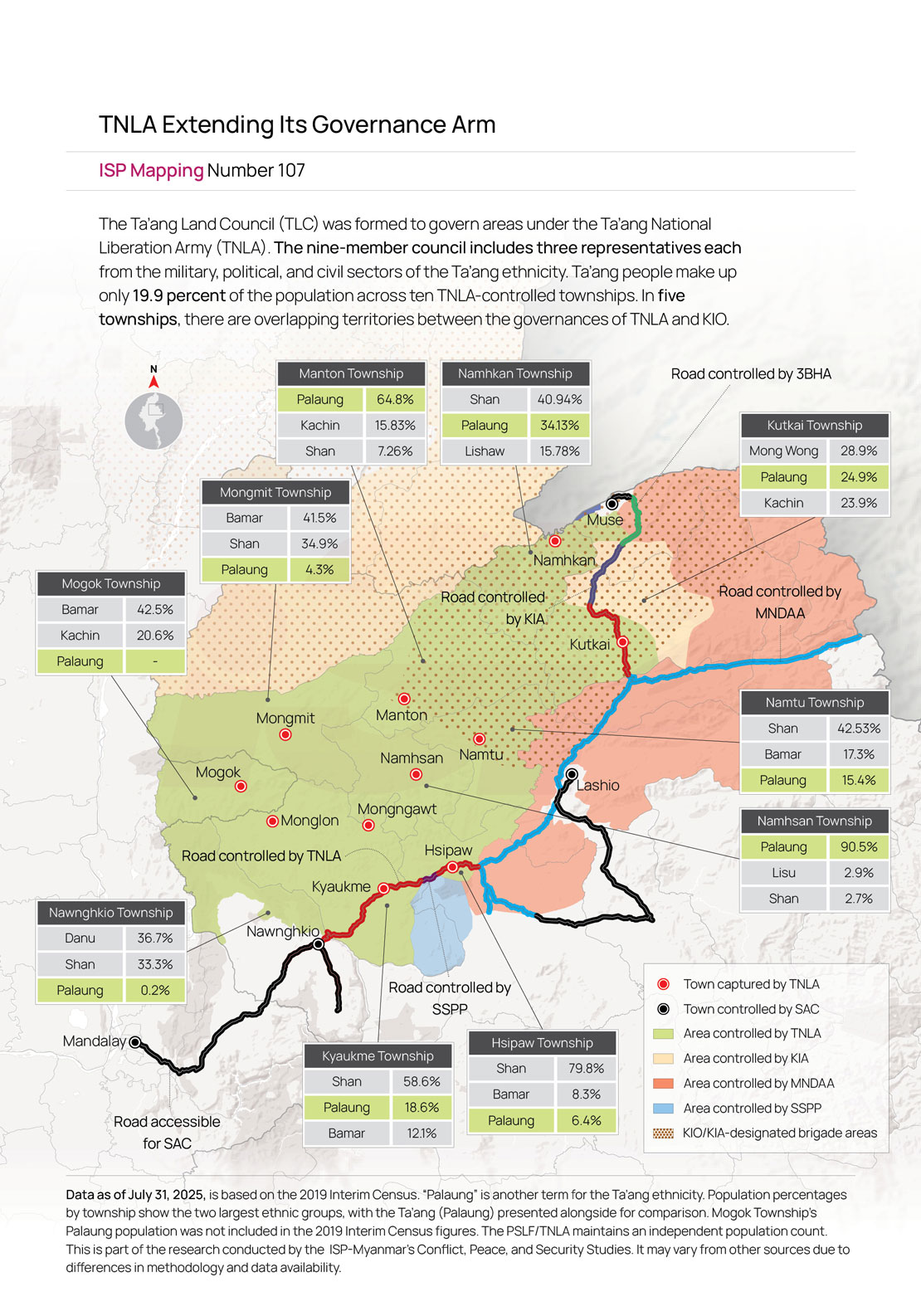
On June 1, 2025, the PSLF/TNLA, which controls 10 townships in northern Shan State and Mandalay Region, formed the Ta’ang Land Council (TLC) as the new governing body in its territories. The council, comprising representatives from the military, political, and civil sectors proportionately, is designed to convert TNLA’s military gains into a coherent system of governance and political authority.
▪️Development
In northern Shan State, where diverse ethnic groups reside and multiple armed factions operate, contested governance mechanisms exist from the TLC, the State Administration Council (SAC), and other ethnic-based Kachin and Shan groups. Parts of the areas designated as “Ta’ang Land” overlap with areas of the KIO’s Southern Division, while the SAC continues counteroffensives in TNLA-controlled zones.
▪️Implications
The TLC faces two main challenges. The first is managing intra- and inter-resistance group relations. Territorial overlaps with the KIO in five townships lead to disputes, risking escalation into armed clashes. The second is balancing relations with local communities (Resistance-Society Relations). TNLA-controlled areas are home to Kachin, Shan, and Bamar populations as well as Ta’ang, who make up roughly 19.9 percent1 of the total population of the areas. The root cause for ethnic tension could lie in the ethnocentric moves, such as making the Ta’ang language an official language. Securing legitimacy among non-Ta’ang communities remains a steep challenge for the TLC.

ISP Governance Tracker
The Ta’ang Land Council’s Looming Challenges
Footnote
- Population data is based on Myanmar’s 2019 Interim Census. The data is part of the ISP-Myanmar’s Conflict, Peace, and Security Studies. ↩︎