

Photo – Telegram/SAC-STR
Summary
The steps taken by the State Administration Council (SAC) at the end of July 2025 signaled that the current military leadership is prepared to use every available means to secure its grip on power. Yet, just months earlier, from November 2023 to August 2024, the Myanmar military endured an unprecedented “ten-month shock.” It found itself hollowed out—bereft of public support, institutional resilience, leadership credibility, technological superiority, and even ideological footing. Mass surrenders and growing perceptions that the junta leader was no longer worth dying for exposed how far the institution had unravelled. On the other hand, most of Myanmar’s neighbors calculated that no cohesive alternative power bloc existed to replace the military if it were to collapse. Unwilling to accept the potential of state collapse following the military collapse, China, Thailand, and others increasingly prioritized preserving the center. Thus, the military was able to “weaponize its weakness”: framing the idea that if the center collapsed, the country would follow, and leveraging this fear to claw back political and strategic space.
Evidence points to three conclusions:
- The Myanmar military is unlikely to face an overnight collapse in the near term.
- Though unable to swiftly regain lost territory, the military will continue to dominate a diminished statehood, coexisting with de facto rival power centers while using coercion and manipulation to govern.
- Resistance forces, though stronger than ever territorially, still cannot replace the military with a more unified and effective alternative. Hardline resistance will vow to persist the revolution.
This raises a central question: will a fourth-generation transition occur within the Tatmadaw, and if so, how? If one accepts the premise that the military cannot be decisively dismantled in the short term, then a generational shift inside the institution is inevitable. The question is not whether it will happen, but when, under what leadership, and in what direction it will steer.
From this vantage point, three strategic issues follow. First, political change in Myanmar may hinge on a fourth-generation transition within the Tatmadaw. Second, the crucial test will be whether this new cohort aligns with popular demands for the military’s withdrawal from politics. Third, resistance forces must grapple with how they can exert pressures and offer incentives necessary to compel such change. In this light, systematic and unbiased strategic study of the Tatmadaw—and of Naypyitawlogy, the close analysis of the military’s decision-making, is no longer optional. It is essential for both Myanmar’s resistance movement and the international community. Otherwise, Myanmar risks repeating a cycle of willful blindness: ignoring what is in plain sight and refusing to acknowledge what is already known.

ISP On Point No.27
Prospective 4th Generation Tatmadaw – Pathways to Reform or Further Regression?
This ISP OnPoint No. 27 (English version), titled “Prospective 4th Generation Tatmadaw- Pathways to Reform or Further Regression?” was published on September 2, 2025, as a translation of the original Burmese version published on August 25, 2025. These are part of the research conducted by the ISP-Myanmar’s Conflict, Peace and Security Studies.
Prospective 4th Generation Tatmadaw1
Pathways to Reform or Further Regression?
▪️Events
The State Administration Council (SAC), which seized power under a state of emergency, did not renew its mandate. On July 31, 2025, it announced the creation of the State Security and Peace Commission (SSPC) to oversee a multi-party general election, with Senior General Min Aung Hlaing still at the helm. BBC Burmese reports that he is soliciting names of council members and senior officers interested in standing for the next election. The current Myanmar Armed Forces (MAF) hierarchy includes five generals and at least 20 lieutenant generals, several of whom may have to throw their hats into the ring.
▪️Preliminary Analysis
The 1962 coup brought in 12 years of military rule through the Union Revolutionary Council, before the formation of the Burma Socialist Programme Party. In 1988, the military seized power again, ruling for a total of 23 years—first as the State Law and Order Restoration Council (SLORC) for nine years, then renamed the State Peace and Development Council (SPDC) until President Thein Sein’s quasi-civilian government took over. In both cases, the military effectively handed authority to itself—same old, same old—but under relatively stable, controlled conditions when its grip was firm.
The shift from the SAC to the SSPC comes at the most unstable moment in the Myanmar Armed Forces’ history. Public support has hit a record low, leaving civil-military relations fragile. The junta’s tightly staged election plan leaves almost no room for error, either within the barracks or in civilian affairs. A slew of new laws makes its intentions clear: the Military Secrets Protection Law; the Law on the Protection of Multiparty Democratic General Elections from Obstruction, Disruption and Destruction; the Cybersecurity Law of July 30, 2025; and amendments to the Protection of Personal Privacy and Personal Security of Citizens Law together create an environment of systematic oppression and fear. A state of emergency now covers 63 townships, suppressing resistance strongholds. The regime has dropped any pretense of change. Even after the election, little points to a “Thein Sein 2.0–style” handover. The current junta chief appears set either to rule directly or to install a loyal proxy, using every tool at his disposal to entrench his dynasty.
Debates over Myanmar’s civil-military relations fall broadly into two camps. One argues that the “fascist military” must be dismantled and rebuilt from scratch, replaced by a federal armed force. The other holds that without internal reform within the MAF, the country will remain trapped in a cycle of conflict, as long as the military persists under its current leadership and insists on dominating politics. This view is common among Myanmar’s neighbours, according to ISP-Myanmar research. Many fear that if the military collapses, Myanmar has no cohesive alternative force to take its place, leaving the country at risk of disintegration. Few in the region are willing to accept such a scenario. Consequently, the strategy of neighbours such as China and Thailand appears aimed at preserving central authority, prioritizing stability over political change.
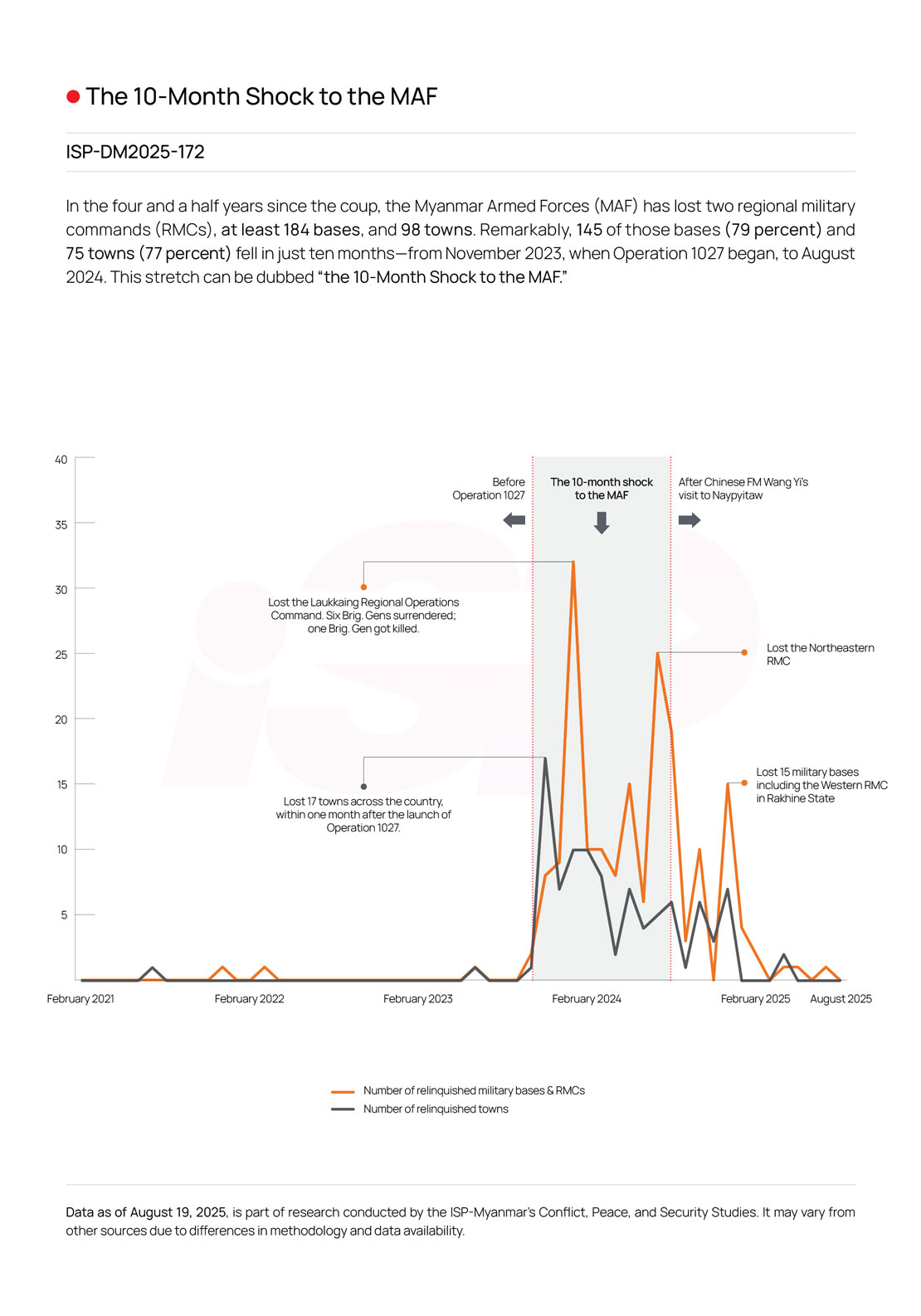
During the critical 10 months from the launch of Operation 1027 in October 2023 to Chinese Foreign Minister Wang Yi’s visit to Naypyitaw in August 2024, the regime faced an unprecedented shock.
Propped up from behind, the MAF survived what ISP‑Myanmar called the “10-month shock to the MAF.” During the critical 10 months from the launch of Operation 1027 in October 2023 to Chinese Foreign Minister Wang Yi’s visit to Naypyitaw in August 2024, the regime faced an unprecedented shock. The phrase “not only unable to raise heads from the bunkers but facing the bunker’s collapse” came to capture more than battlefield losses. The period was defined by unraveling: public support eroded, institutions buckled, leadership faltered, and both technological and ideological foundations crumbled. Mass surrenders swept the ranks, the military lost its first regional command, and many soldiers concluded that loyalty to the leader was no longer worth the cost. In a June 2024 broadcast of 30 Minutes with the ISP, the period for the critical condition of the Myanmar military was summed up in three words: stormy, hollowed-out, corrosion.
During this 10-month shock, both the United States and China deliberated on how to respond. In June 2024, Daniel Kritenbrink, the US Assistant Secretary of State for East Asian and Pacific Affairs, met the regime’s representatives in Vietnam. The talks produced no meaningful progress toward a political settlement. Ultimately, with China’s assistance, the regime navigated the crisis by weaponizing its weakness— the notion that if the center collapses, the country would follow (see SWOT analysis, page 8). ISP‑Myanmar highlighted China’s process strategy in detail during this period (see ISP On Point No. 21).
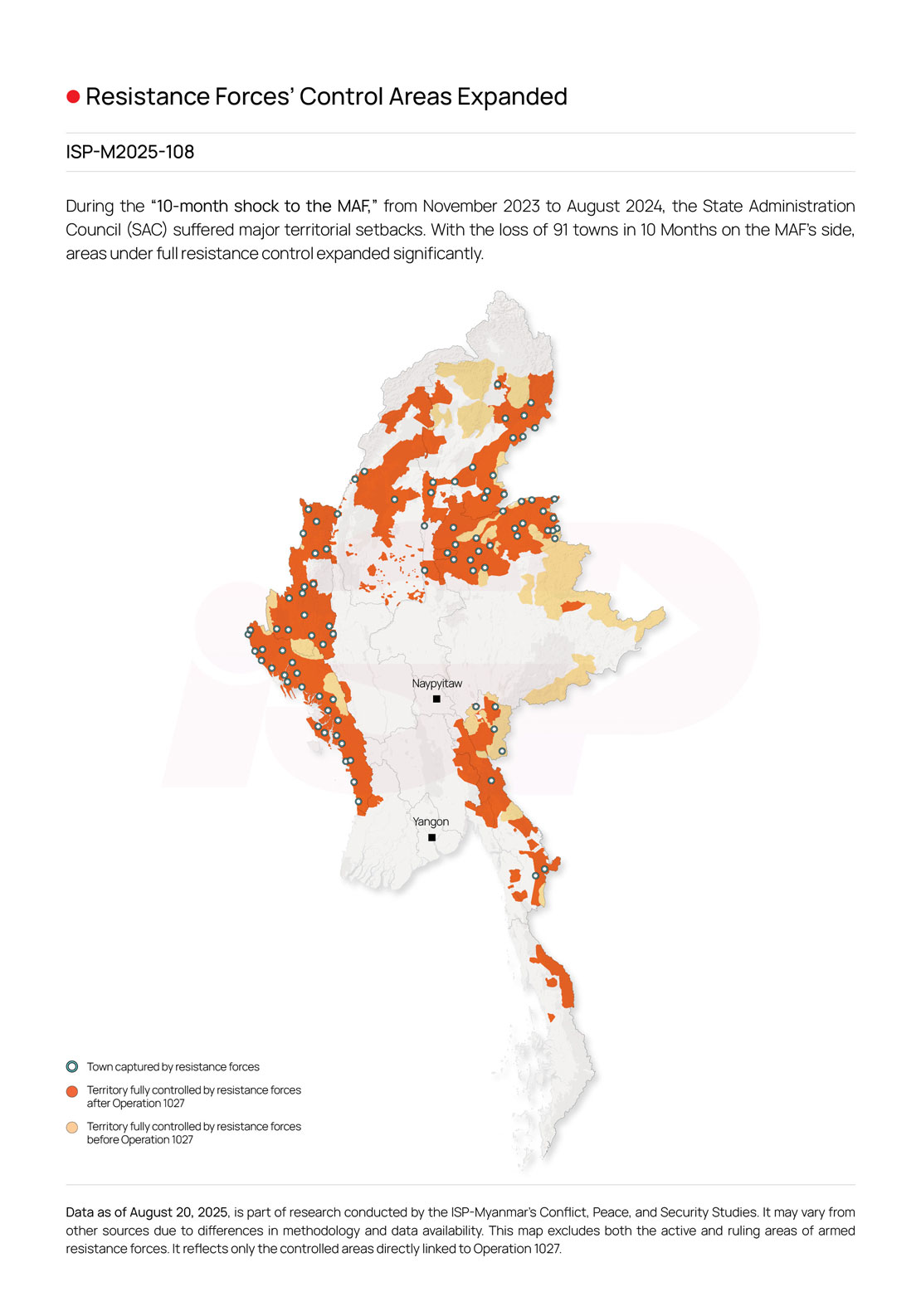

Support from China and other neighbours, notably Thailand, has delivered the junta three key gains (see ISP On Point No. 22). First, diplomatic isolation has eased: Senior General Min Aung Hlaing was able to attend the Bay of Bengal Initiative for Multi-Sectoral Technical and Economic Cooperation (BIMSTEC) summit and meet Malaysia’s prime minister, the current ASEAN chair. Second, while resistance forces grapple with arms shortages caused by China’s “Five Cuts” strategy, the military has secured supplies to scale up drone and airstrike operations. Third, it was able to fuse political manoeuvres—including elections—with military strategy. The impact of these advantages has become more apparent in the wake of the Sagaing-Mandalay earthquake.
On the battlefield, it could remain mired in a cycle of gains and reversals. At the strategic level, the war has reached a stalemate: neither side can be decisively beaten. Three factors explain this. First, though weaker than at any other time in its modern history, the MAF is unlikely to face an overnight collapse soon. Second, resistance forces now hold more territory than ever before, but remain divided, without a unified command or a common political end-goal and the profits of the conflict economy, meanwhile, give many armed groups a reason to keep fighting. Third, as the US has retreated from the liberal world order, China has stepped into the geopolitical order in the region to brake Myanmar’s resistance momentum. From these dynamics, a series of hypotheses arises. The MAF cannot easily recover what it has lost, but nor will it collapse; it can still coercively and manipulatively maintain control over a diminished statehood. The opposition lacks the means and cohesion to replace it with something better. Taken together, the hypothesis suggests that Myanmar’s political future could hinge less on the outright defeat of the MAF and more on the prospect of reform within it. It is a bitter truth and a sobering conclusion, but one that requires moving beyond motivated reasoning—like emotional appeals to “uproot and destroy” the military regardless of circumstances— and endogeneity in thinking. Without such a shift, the search for resolution risks becoming an endless Catch-22.
If the regime, bolstered by China and some neighboring states, cannot be defeated militarily in the near future (and if Myanmar’s resistance war once again drags into protraction) the prospect of political change is inevitably tied to the likelihood of reform within the MAF itself.
In reviewing recent history, since 1988, Myanmar’s revolutionaries have repeatedly failed to transform social movements, such as the 1988 Democracy Movement, the Saffron Revolution of 2007, the Spring Revolution of 2021, landslide electoral victories in 1990, 2015, and 2020, and even armed advances like Operation 1027, into lasting political change. All fizzled before they could deliver irreversible political gains. Whenever a cycle of resistance and oppression reaches a stalemate, it ends with the MAF finding a way out—usually one that strengthens its hand. Myanmar’s resistance or conflict is not a linear march toward its goals, but a cyclical process driven by a new generation, emerging technologies, and changing geopolitical currents.
Today, once again, the military is trying to break the stalemate of the post-2021 cycle of resistance and oppression. This time, it leans on the planned 2025–26 elections and Chinese backing to preserve its grip on power (see diagram of Four Cycles of Resistance and Oppression—and Their Disruptions on page 12). Therefore, if the regime, bolstered by China and some neighboring states, cannot be defeated militarily in the near future (and if Myanmar’s resistance war once again drags into protraction) the prospect of political change is inevitably tied to the likelihood of reform within the MAF itself.
This assessment raises several questions: what would military reform look like, how might it come about, and who could drive it? At its heart, reform would mean the army’s retreat from politics—something long demanded by the Myanmar public. Whether that retreat happens immediately or in stages will depend on two factors: first, the balance of power, including the strength of public support, available resources, and foreign alliances, and second, the effectiveness of the negotiation skills employed by the parties involved in the conflict. For now, there is little sign that Senior General Min Aung Hlaing intends to pursue MAF reform. Therefore, it is even more crucial to examine the potential for generational change within the MAF—and the possible policy shifts that could result.
The Tatmadaw can be observed in three distinct generational phases. The first generation (1940–88) was dominated by the Thirty Comrades, the independence‑era fighters who founded the army. The second (1988–2011) was led by Senior General Than Shwe during the SLORC and SPDC years. The third (2021–present) is under the single-handed command of Senior General Min Aung Hlaing. Although General Aung San is revered as the father of the Tatmadaw, his influence is largely symbolic; the institution’s real architect was General Ne Win, one of the Thirty Comrades, who set its doctrine and character for decades. Under Ne Win, the Tatmadaw shifted from an anti-colonial liberation force to a serial coup-maker, embedding itself in politics and adopting the mantle of a socialist-authoritarian state. His first-generation rule was marked by strident Bamar-chauvinist ideology, a closed economy, authoritarian consolidation, and isolationist state. Civil-military relations were defined by repression. Deprived of legitimacy, the regime eventually collapsed under the weight of the 1988 pro-democracy uprising—bringing an end to the Tatmadaw’s first generation.
Although Senior General Saw Maung fronted the 1988 coup, it was his successor, Senior General Than Shwe, who came to define the Tatmadaw’s second generation. With a long grip on power, he shaped both the army’s image and its institutional character. Under his rule, the military cast itself as guarantor of “law and order,” brokered ceasefires with ethnic armed groups, and entrenched its political dominance through the 2008 Constitution. The regime prioritized pragmatism over ideology—strengthening the military as an institution while extending its reach through a crony-capitalist system. Than Shwe combined tight strategic control with tactical flexibility, often “playing both fire and water.” Yet repression remained the default in civil-military relations, eroding public support. The 2007 Saffron Revolution and the disastrous response to Cyclone Nargis, which left hundreds of thousands dead, exposed the regime’s weakness. As a means to manage political transition, the Tatmadaw’s second generation withdrew from direct military rule, instead embedding itself in politics through the power granted by the 2008 Constitution.

The Tatmadaw’s third generation is led by Senior General Min Aung Hlaing, who seized power in 2021. His rule has reversed the limited political liberalization introduced by his predecessors. While professing to defend the 2008 Constitution, the very act of seizing power could be legally argued as a violation of that charter. This generation is defined by regression: from a quasi-civilian government to a dictatorship rooted in personal ambition, nationwide uprisings, full-blown civil war, and unprecedented battlefield defeats. Despite gestures toward populism, the regime has consistently failed to meet popular demands. Adopting a strategy of expediency, it has focused narrowly on survival—avoiding collapse and muddling through the crisis—while leaning on China and Russia for diplomatic cover. On the civil-military relations front, Min Aung Hlaing has chosen repression over pragmatic compromise, igniting resistance and driving public support for the Tatmadaw to historic lows.
Despite differences in leadership style, public support, engagement with ethnic groups, and shifting international contexts, all three generations of the Tatmadaw have shared one conviction: that they are the guardians of the state— a role assumed as much as imposed. The question now is whether this self-appointed mission will endure into a fourth generation of military leadership.
▪️Scenario Forecast
The prospect of a fourth‑generation Tatmadaw raises several questions: is such a transition possible, how might it unfold, who would lead it, and what priorities would it pursue? If one assumes the military will not collapse in the near future (assuming it remains difficult to decisively defeat or dismantle the military in a short term), such a generational shift is inevitable; the only question is when. Rather than emerging from an internal counter‑coup (except for the unexpected retirement of Senior General Min Aung Hlaing), it is more likely to follow the elections, after a period of adjustment. Its timing will hinge largely on the outcome of post‑election negotiations and compromises between the main resistance forces and the regime.
General Kyaw Swar Lin of Defence Services Academy (DSA) Batch 35 is widely tipped as the most plausible successor, though some caution that those appearing too favored rarely prevail. He could act as a guarantor of Min Aung Hlaing and serve as a transitional commander‑in‑chief. This might entail retiring officers senior to Batch 35, with the core of the fourth‑generation leadership drawn from Batch 38 officers (such as Lt. Gen. Ko Ko Oo, Lt. Gen. Than Htike, Lt. Gen. Htein Win, and Lt. Gen. Zaw Hein, etc.) and RMC commanders from Batches 40 and 41 are also likely to play pivotal roles in shaping the next tier of leadership.
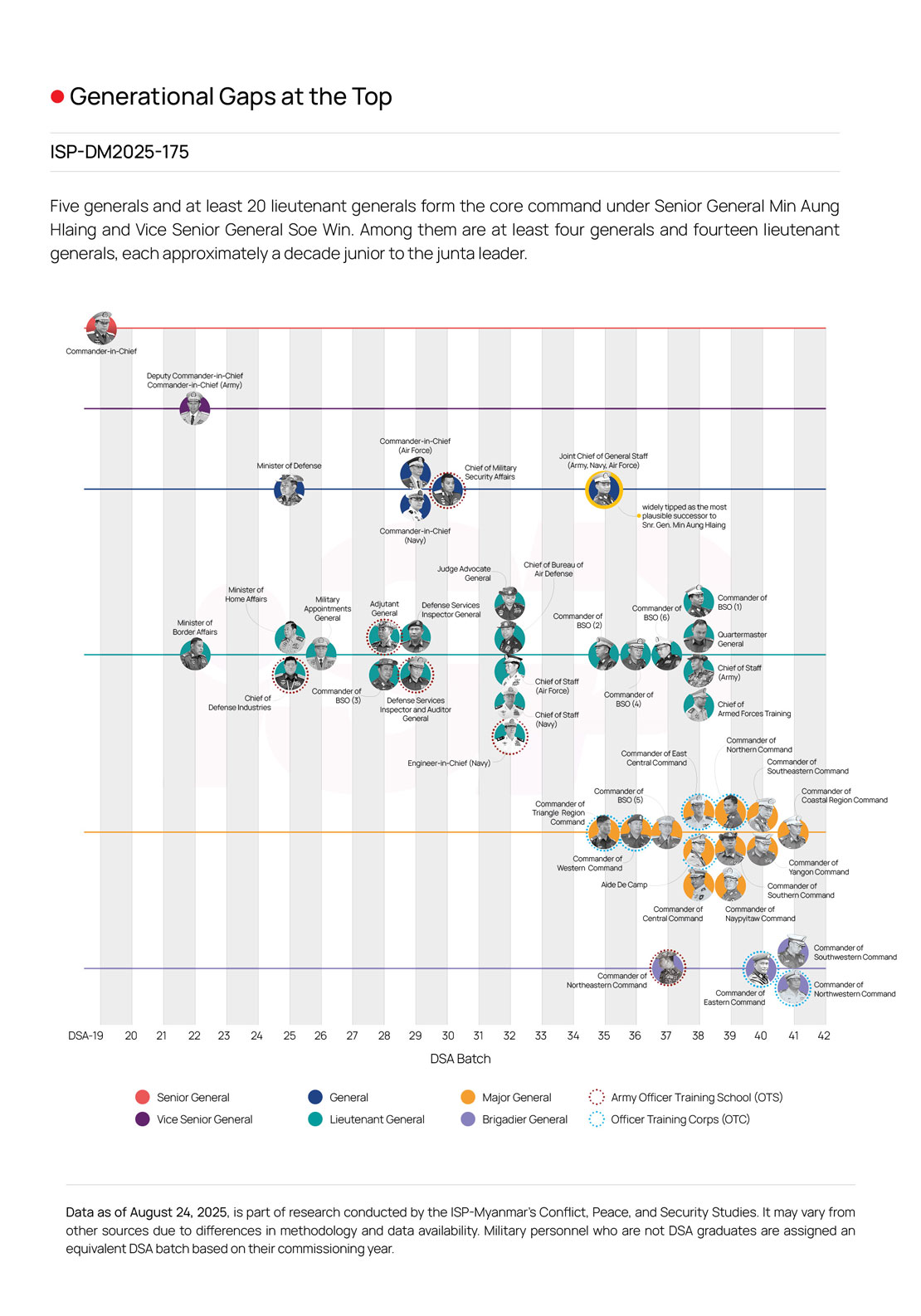
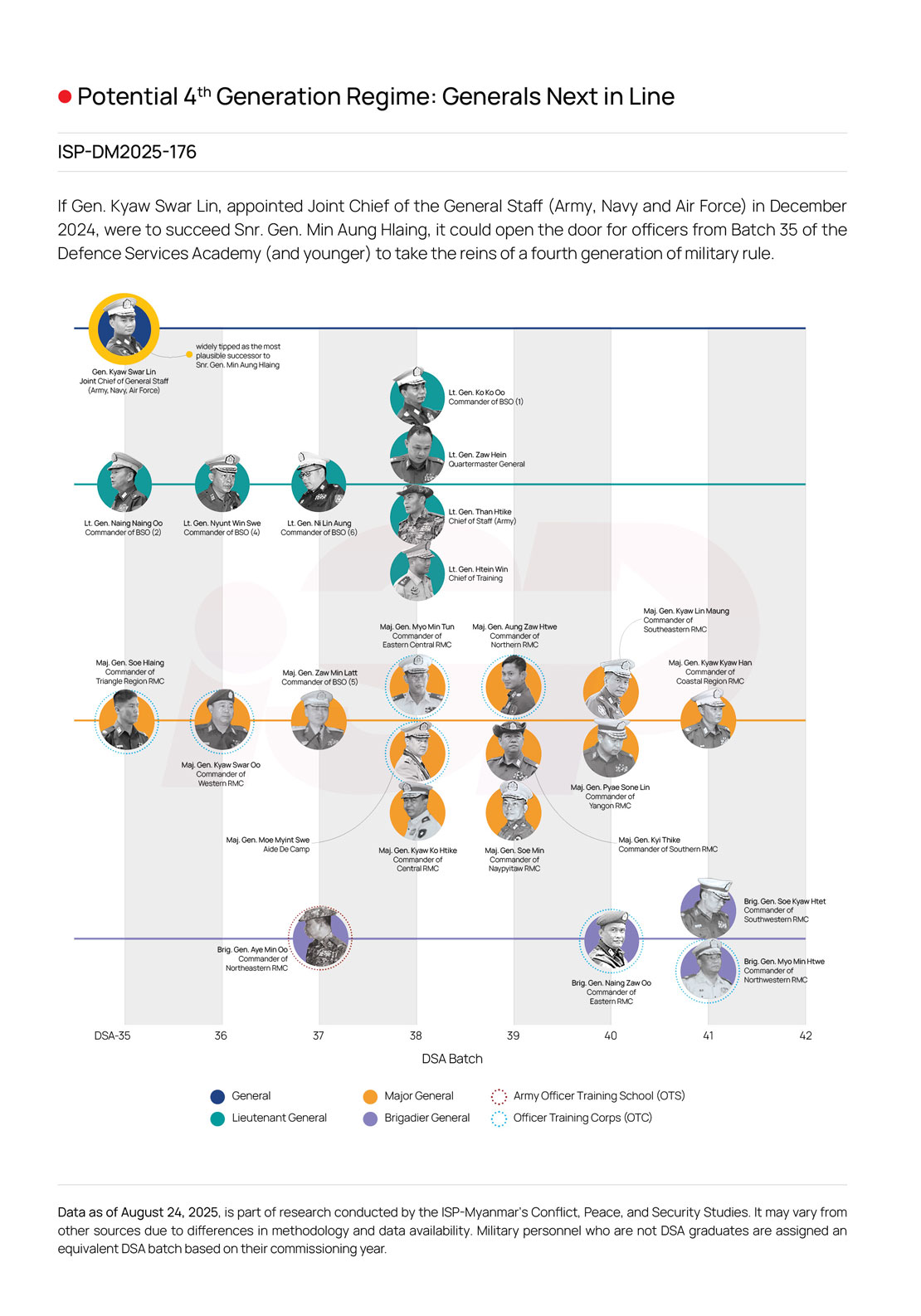

For now, it is difficult to predict what course a fourth-generation Tatmadaw might take. Though, three tendencies are already visible. First, survival under Senior General Min Aung Hlaing, with officers displaying unflinching loyalty to avoid being purged, sidelined, or worse. Second, an ambition to rebuild and strengthen the armed forces after years of attrition. Third, a conviction that ethnic armed organisations are not genuine in their calls for democracy or federalism, but instead exploit armed struggle to inflame anti-Bamar sentiment, pursue economic interests, and destabilise the state—thereby justifying a revival of Bamar nationalism. Like their predecessors, the fourth generation is therefore likely to see itself as the nation’s self‑appointed guardian. The difference, if any, may only be a matter of degree, with little substantial change in essence.
Potential fourth‑generation commanders have already built personal economic networks and patronage systems, often through patron-client ties. Promotion would be swifter if they can be seen crushing the resistance and securing clear victories. Many expect that, after the election, if Senior General Min Aung Hlaing were to transition from commander-in-chief to a civilian presidency, he would hand over day-to-day military management to a trusted aid, allowing the fourth generation to assume control gradually. Yet there are fears he may cling to power, either through the newly created State Security and Peace Commission (SSPC) or a body modeled on China’s Central Military Commission. They also fear arbitrary purges without mercy, such as the case of General Moe Myint Tun. Min Aung Hlaing’s divide‑and‑rule tactics appear aimed at preventing potential successors from uniting against him. All are bound together by a system of collective responsibility for wartime atrocities, ensuring all senior officer are complicit in war crimes. How firmly this emerging generation defends the 2008 Constitution will be the key test of its political intent.
To summarize, the changes announced by the SAC at the end of July chiefly signal that the current commander‑in‑chief is using every available lever to prolong his rule. The evidence suggests three main points. First, the Tatmadaw is unlikely to collapse in the near term. Second, while it cannot easily recover lost territory, it will likely continue to dominate a diminished state, coexisting with de facto rival power centers and ruling through a blend of coercion and manipulation. Third, as the resistance forces cannot yet replace the MAF with a stronger alternative and remain fragmented, the hardline resistance groups vow to persist the revolution for future generations. Taken together, these hypotheses suggest that Myanmar’s political future hinges on a fourth-generation transition within the MAF—whether this cohort heeds public demands for withdrawal from politics, and whether resistance forces can muster the pressure and incentives to force such a shift, remain open questions. If so, systematic and unbiased strategic study of the Tatmadaw—and of Naypyitawlogy, the study of Naypyitaw—becomes essential for both the resistance and the international community. Without it, Myanmar risks repeating a familiar pattern of wilful blindness: ignoring what is in plain sight and refusing to acknowledge what is already known.


ISP On Point No.27
Prospective 4th Generation Tatmadaw – Pathways to Reform or Further Regression?
Footnotes
- Since Myanmar’s independence, resistance groups have shunned using the military’s official Burmese name, the Tatmadaw. Instead, they preferred to dub it such as the “Ne Win–San Yu Army,” “Burmese Army,” or simply “enemy’s army.” Since the 2021 Spring Revolution, politicized nomenclature has gained ground. This reflects the view that some terms are never neutral: they carry political agendas and signal bias. As part of an effort to counter the regime’s self-serving propaganda, which refers to itself as Tatmadaw with a positive connotation, the Burmese term Sit-tat, a generic label for the military, has come into wider use. Historically, however, Sit-tat was not inherently derogatory and often appeared in informal or colloquial contexts. For example, a 1951 sermon, The Sit-tat Sermon, delivered by the influential Buddhist monk Venerable Mahagandhayon Sayadaw Ashin Janakabhivamsa, illustrates such neutral usage. Language change can alter connotations over time, as seen in the evolving meaning of chwe-tat (originally a positive term for a voluntary army of civilian laborers and porters who worked with their sweat, later shifting to denote forced labor and losing its sense of dignity and hard work). In this article, ISP–Myanmar uses Tatmadaw to refer to the institution’s official name when discussing its history and trajectory. This historical‑institutionalist approach facilitates analysis of the military’s self-perception, character, evolution, critical junctures, and possible futures. Whenever needed, using the term Tatmadaw ensures clarity, accessibility, and easy cross-referencing with existing literature and official records. The terms Myanmar Armed Forces (MAF) or Myanmar military are also used where context requires, without implying political partisanship. ↩︎
This disgusting distortion has a delusional premise: That tweaks within the genocidal regime matter. In actual fact, if the junta, under whatever new name it adopts, is left with any vestige of power, it will contrive to retake all of it, and the whole cycle of brutality will repeat. That is why the resistance continues to insist on the wholesale “uprooting” of the murderous regime, regardless of how long that takes.